
Sul ponticello changes a bowed string sound by moving towards the bridge
Hear how sul ponticello changes a bowed string’s colour near the bridge, and compare it with ordinary bowing without confusing brightness with loudness.

Hear how sul ponticello changes a bowed string’s colour near the bridge, and compare it with ordinary bowing without confusing brightness with loudness.

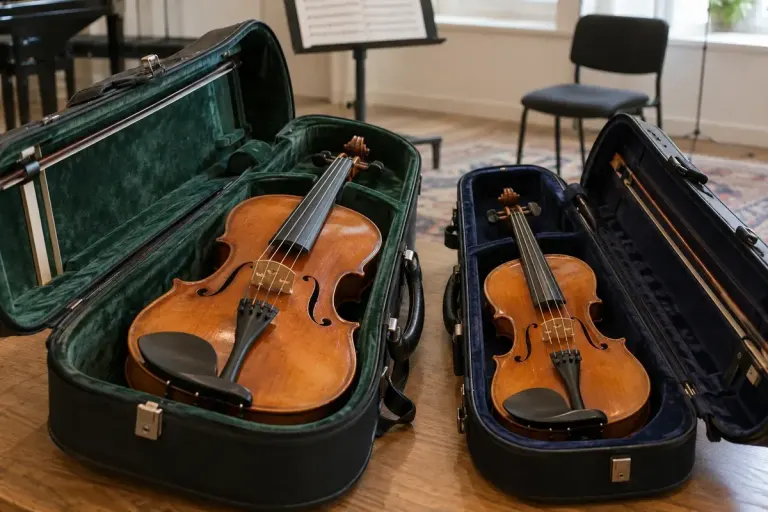
Listen for the viola’s lower string range and middle voice, and discover why it is more useful to follow its musical role than call it a large violin.

Trills alternate neighbouring notes, while tremolo can describe repeated notes, chords or other effects. Read the musical context before deciding how to play.

Explore enharmonic notes at the piano and see why C-sharp and D-flat can share a key while keeping different written names.

Watch an acoustic accordion’s bellows as well as its keys to understand airflow, phrasing and why a sustained note can change in intensity.

Sostenuto can sustain selected notes while later notes remain separate. Check the piano’s pedal function before trying a short listening experiment.

Hear how an ostinato holds a repeating pattern while melody, harmony or instrumentation changes around it, using a simple listening exercise.

Hear how the soft pedal changes a piano’s attack and colour, and why the left pedal on an upright does not work exactly like one on a grand.

A prepared piano changes the strings’ response before performance. Listen for its altered timbre without assuming every piano-like sound has the same source.