
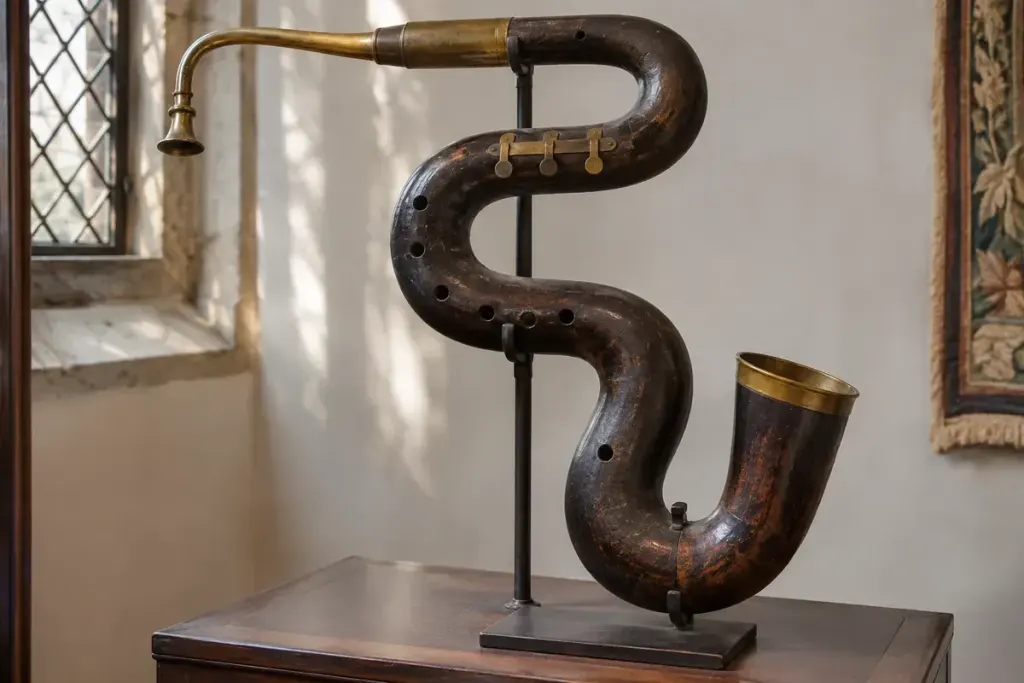
A winding wooden body, dark covering and finger holes make the serpent look unlike a modern brass-section instrument. Yet the player’s lips start the sound at a mouthpiece. The object is a good reminder that an instrument’s family cannot be identified from its construction material alone.
The Metropolitan Museum of Art’s serpent record describes it as a bass brasswind instrument and lists wood, leather, paint and brass among the materials. The Galleria dell’Accademia’s explanation connects its finger holes with lip-generated sound at the mouthpiece.
Separate three things you can observe
First, identify what sets the air vibrating. Second, look at how the player changes the sounding length or pitch. Third, notice what the body is made from. Those questions may point in different directions if you rely on everyday labels.
For the serpent, the finger holes can invite a comparison with familiar woodwinds, while the mouthpiece directs attention toward lip vibration. The curved form is another feature to examine, but its striking appearance does not itself explain how the note begins.
Listen before deciding what it resembles
When a museum or performer provides a recording, listen once without looking at the photograph. Write a few ordinary descriptions of the sound, then watch how the performer produces and changes it. Treat your resemblance to a tuba, bassoon or voice as a listening impression, not a classification rule.
Record the performer and instrument information with the clip. Different instruments, playing approaches and recording conditions can change the impression. A short online sample should not stand in for every historical use of the instrument.
If you see a preserved example, follow the museum’s display rules and use its collection record for date and maker. The rewarding discovery is the relationship between the unusual object and the player’s action: wood can form the body while the lips supply the vibration that places the serpent in a different musical family.