
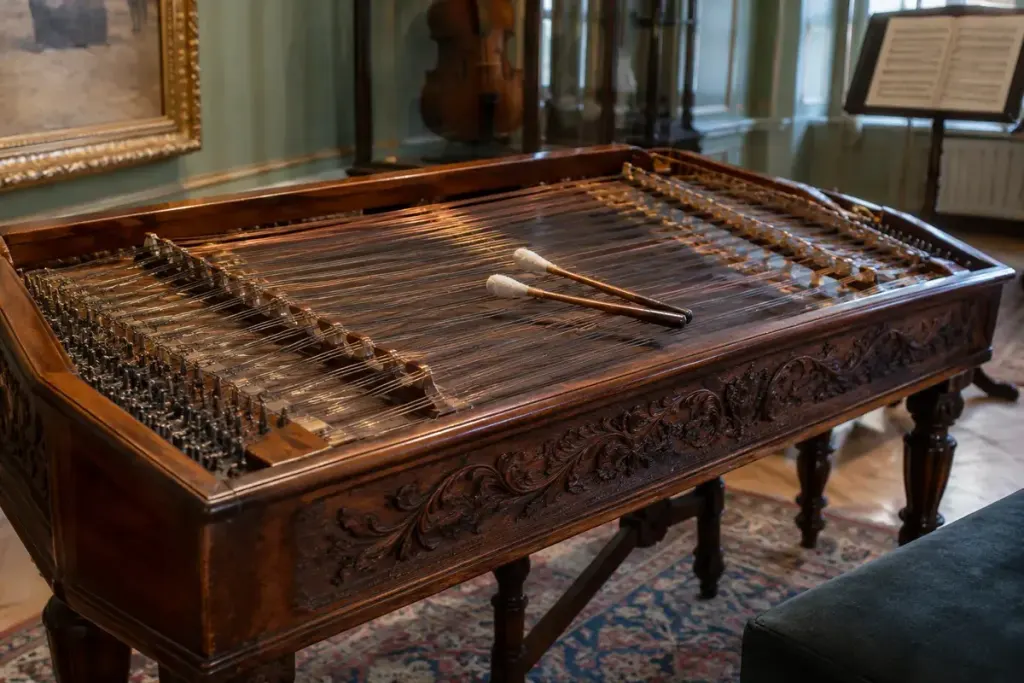
From a distance, the instrument may look like a wide table. Up close, strings stretch across its soundboard, and the player holds small beaters rather than using a keyboard. The cimbalom belongs to the family of hammered dulcimers.
Ringve Music Museum’s account describes the Hungarian instrument’s metal strings being struck with two beaters. The museum also discusses its place in musical history. That physical action is a helpful starting point for hearing it within a busy ensemble.
Listen from the beginning of a note
Choose a recording or performance that clearly identifies the instrument. First listen for the attack: the brief instant when a beater meets a string. Then follow what remains as the sound rings and fades. Try the same passage again while watching the player’s hands, if a clear video is available.
Do not decide that every bright, ringing sound is a cimbalom. Other struck-string instruments and electronic sounds can overlap in character. Programme notes and performer credits are stronger identification evidence than timbre alone.
Notice how the phrase is shaped
Does the player repeat a note rapidly, move between registers or let a chord linger beneath another instrument? Write down one moment that caught your attention and return to it. You do not need to identify every pitch to hear a change in texture.
The Metropolitan Museum of Art’s catalogue entry for a Schunda cimbalom offers a visual reference for a historical example. Use such an object record to understand that instrument, rather than assuming every cimbalom has identical dimensions or equipment.
If you attend a demonstration, let the musician explain the particular instrument before asking to touch it. Strings, bridges and tuning parts are working components, not decorative details.
A short listening note can be enough: “clear struck attack, lingering resonance, repeated notes under the melody”. It gives your next encounter a point of recognition while leaving room for the range of ways musicians use the instrument.