
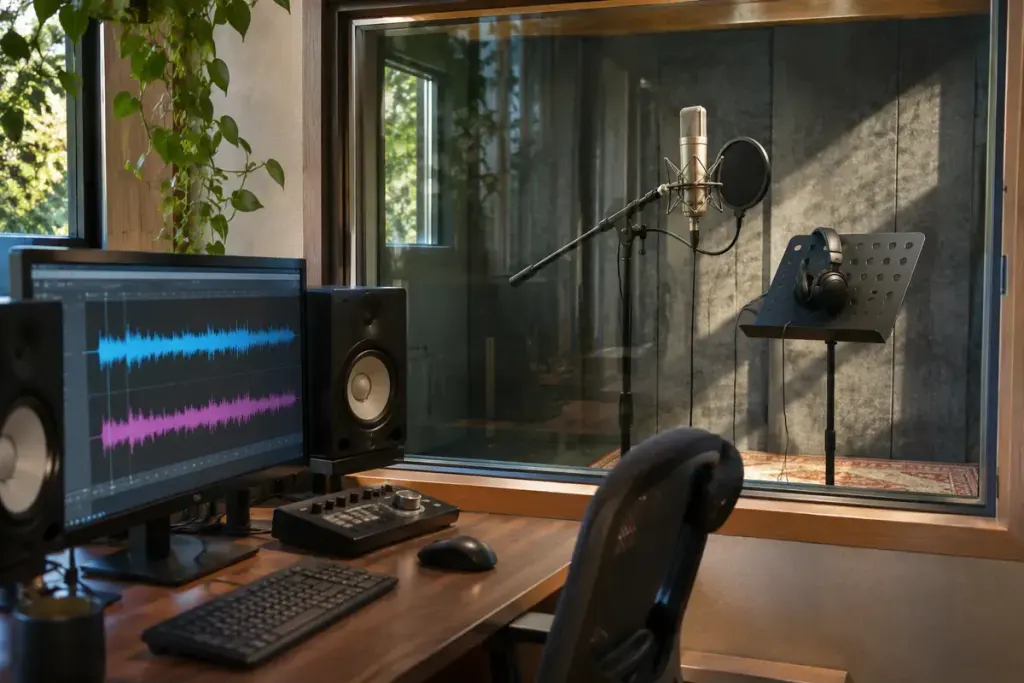
A vocal can become fuller without adding a new harmony. One way is to record the same part again and combine the performances. Small differences in timing, pitch and articulation create an effect that simply duplicating the original audio does not provide.
iZotope’s explanation of double tracking describes recording another performance of the part. Its discussion of basic doubling techniques distinguishes that from copying an identical recording and from processing designed to simulate variation.
Make a short comparison
Choose one phrase you can sing comfortably and record a lead take. Record a second take while listening to the first at a comfortable level. Aim for the same words and phrasing, but do not expect the performances to become mathematically identical.
Listen to the lead alone, then bring in the second performance quietly. Keep playback loudness reasonably comparable so that “louder” is not mistaken for “better.” Notice which parts become richer and which become harder to understand.
Consonants, breaths and word endings are useful places to listen. A second “s” arriving late may draw more attention than a small vowel difference. Decide whether that looseness suits the song before editing it away.
Use the effect where it earns its place
Try the double on one chorus line or a few important words rather than automatically running it through the entire song. The contrast between a single voice and a doubled passage can be part of the arrangement.
For an illustrative session note, write: “Double supports the long vowel, but the final consonant is distracting.” That tells the singer or editor what to address. A note such as “make it wider” leaves the intended change less clear.
Check the result in the full mix and in mono. A sound that impresses in isolation may obscure a lyric or compete with another instrument once everything plays together.
Artificial doubling is also a creative option, but label the process accurately. A second performance, a delayed copy and a pitch-modulated effect are different tools. Choose by listening to the role the vocal needs to play, not by assuming that more layers always make a stronger recording.