
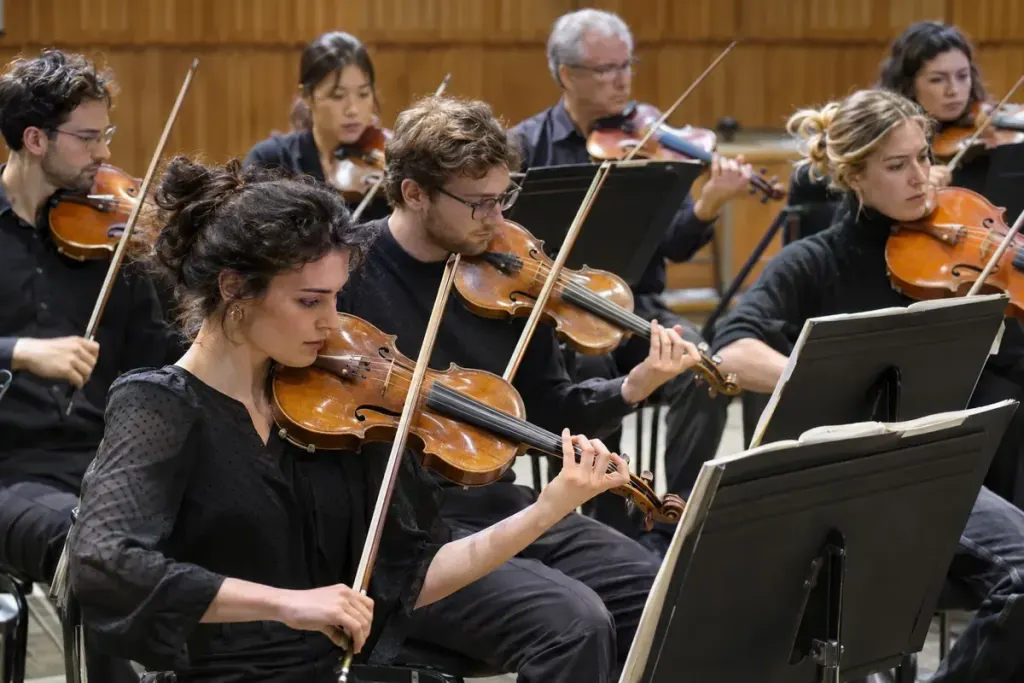
Two notes appear at the same moment in a string part. That does not always mean every player must sound both. A divisi instruction divides the section’s players between notes or lines, changing how the group produces the written harmony.
Vienna Symphonic Library’s string-notation integration guidance illustrates the practical distinction between assigning divided parts and playback that treats several notes as one section’s combined material. The software details belong to that setup, but they highlight an orchestration issue: notation, allocation and playback need to agree.
One section, different assignments
In a simplified example, imagine eight violinists assigned to a two-note passage. A divided allocation might give four players the upper line and four the lower line. That is an illustration of sharing the work, not a rule that every divisi passage splits a section into equal halves. The score and the performance arrangements determine the assignment.
Compare that with asking each player to play a suitable double stop. The written pitches might overlap, but the distribution of players and the physical task differ. Instrument technique, balance and musical intention all affect the choice.
A listening exercise with a limit
Choose a recording for which you can consult an authorised score or performance explanation. Find a passage marked divisi, then listen for the separate lines as they move. Do not assume that a recording alone will let you count exactly how many musicians were assigned to each note.
For a digital mock-up, label which sound or track represents each group and check the resulting balance. Simply stacking several full-section patches can imply more players than the intended orchestration. A convincing playback still needs to be checked against the written intention and the library’s behaviour.
Divisi is a small word with an ensemble-sized consequence. It tells you to think about who plays each line, not only which pitches are present at a particular instant.