
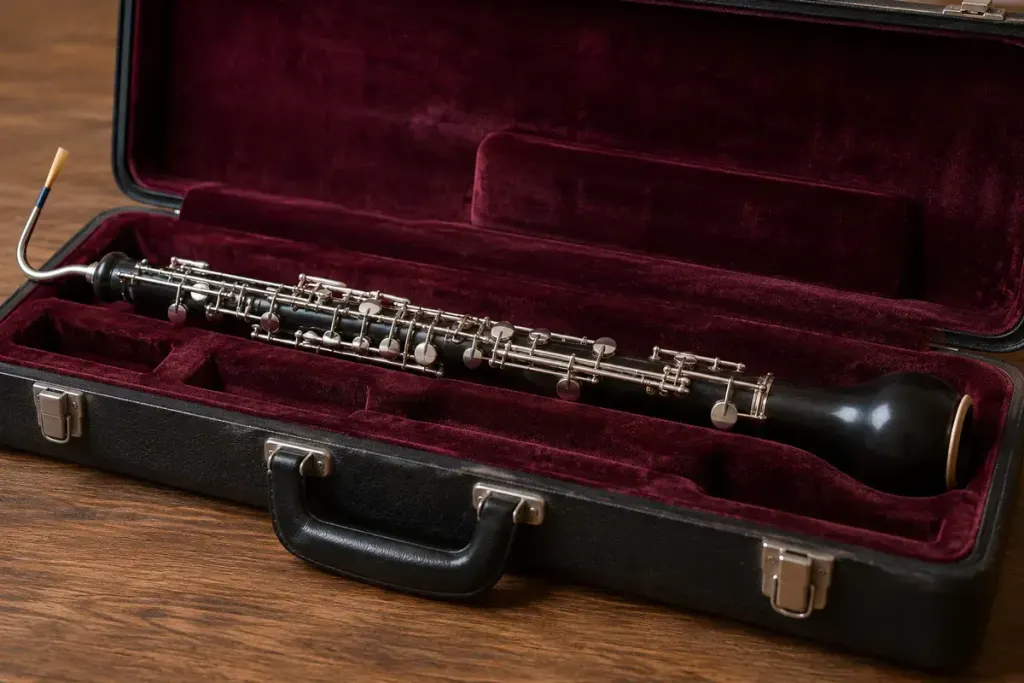
Despite its French name meaning English horn, the cor anglais belongs to the oboe family. That is a more useful starting point for listening than expecting the sound of a brass horn.
The Philharmonia’s instrument guide describes its double reed and pear-shaped bell. It is larger and lower-pitched than the oboe. Those visible and audible differences help a listener recognise the instrument without assuming that every warm woodwind melody must be a cor anglais solo.
Listen for a role, not a mood label
The instrument is often described with words such as mellow or plaintive, but a single adjective cannot explain every passage. Listen to what the melody does: does it sustain long notes, answer another instrument or move through a quicker phrase? The surrounding strings, winds and harmony also shape the impression.
Try an instrument demonstration first, then a recording in which the programme or score identifies a cor anglais part. The demonstration gives you a relatively clear reference. The orchestral passage shows how that voice blends, emerges or disappears inside a larger texture.
A short listening exercise
On the first hearing, follow the melody without trying to name the instrument. On the second, note where the sound enters and which other instruments accompany it. On a third, compare the attack and the end of a phrase with an oboe example.
Use a programme note or score to check your impression. A recording’s microphone placement and the player’s approach can affect what reaches you, so an uncertain identification is not a failure. It is a reason to look for better context.
At a live concert, you may also notice the player’s angled reed connection and the instrument’s rounded bell. Observe from your seat without treating visual recognition as the whole experience. The most rewarding detail is often how the composer gives that particular voice something different to say within the ensemble.