
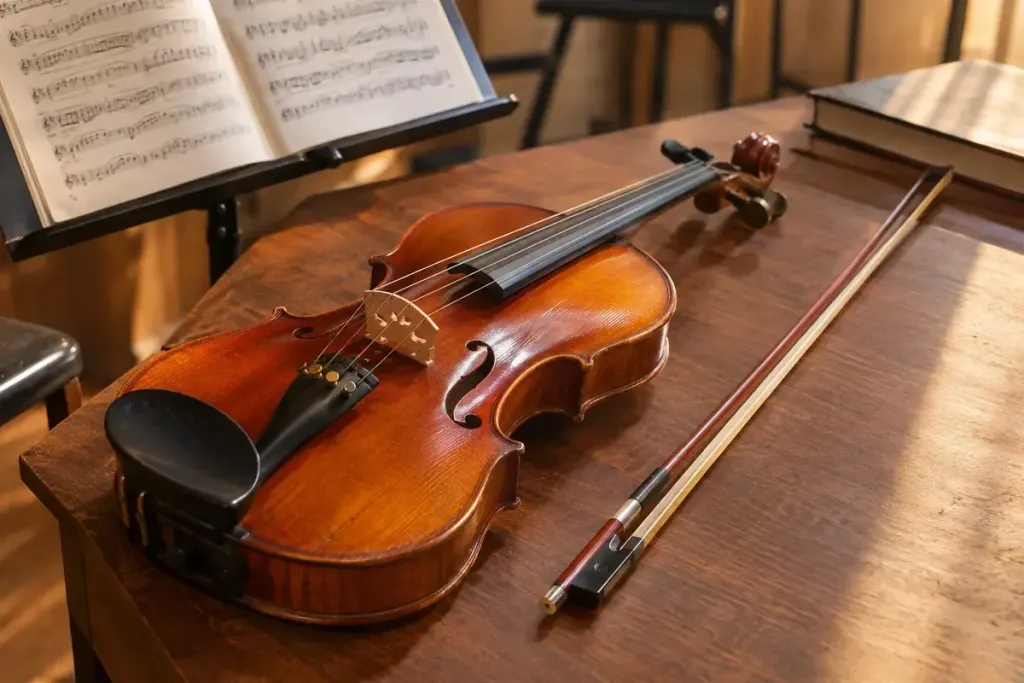
A string part can become a line of dry taps even while the players still hold their bows. The sound may make you look towards the percussion section, but the change can come from the strings themselves. Col legno asks the player to bring the wood of the bow into contact with the string.
Two words describe two different actions
The Birmingham Contemporary Music Group’s viola resource distinguishes col legno battuto from col legno tratto. In battuto, the wooden side strikes the strings, producing a percussive effect. In tratto, the wood is drawn across them, giving a more wispy sound. Those are different instructions, not interchangeable descriptions of playing quietly.
Vienna Symphonic Library’s violin guide also separates striking from bowing with the wood. Its account is useful when a programme note uses only the broader term col legno: the phrase identifies the material involved, while the fuller instruction tells you what the player does with it.
Listen once for the action, once for the role
Try a short passage in two listening rounds. First, concentrate on the beginning of each sound. Does it arrive as a series of separate taps, or continue as a more drawn-out texture? If a performance video is available, compare your impression with the visible bow movement. A sound alone is not always enough to identify a technique confidently in a dense orchestral mix.
On the second round, follow the surrounding instruments. Does the changed string sound mark a pulse underneath a melody? Does it interrupt something smooth? Does another section respond to it? These questions are more revealing than assigning the effect a fixed mood such as “frightening”. The same physical action can serve different musical purposes.
For an informal listening note, divide a page into “what I heard” and “what I think it did”. “Short, repeated attacks” belongs in the first column. “Made the passage feel unsettled” belongs in the second. Keeping the two apart leaves room to revise your interpretation after another hearing.
If you play a string instrument, ask your teacher about a suitable bow and technique before experimenting. For listeners, no instrument is needed: a score marking, a clear demonstration and a second hearing can turn an unfamiliar tapping sound into an audible musical decision.