
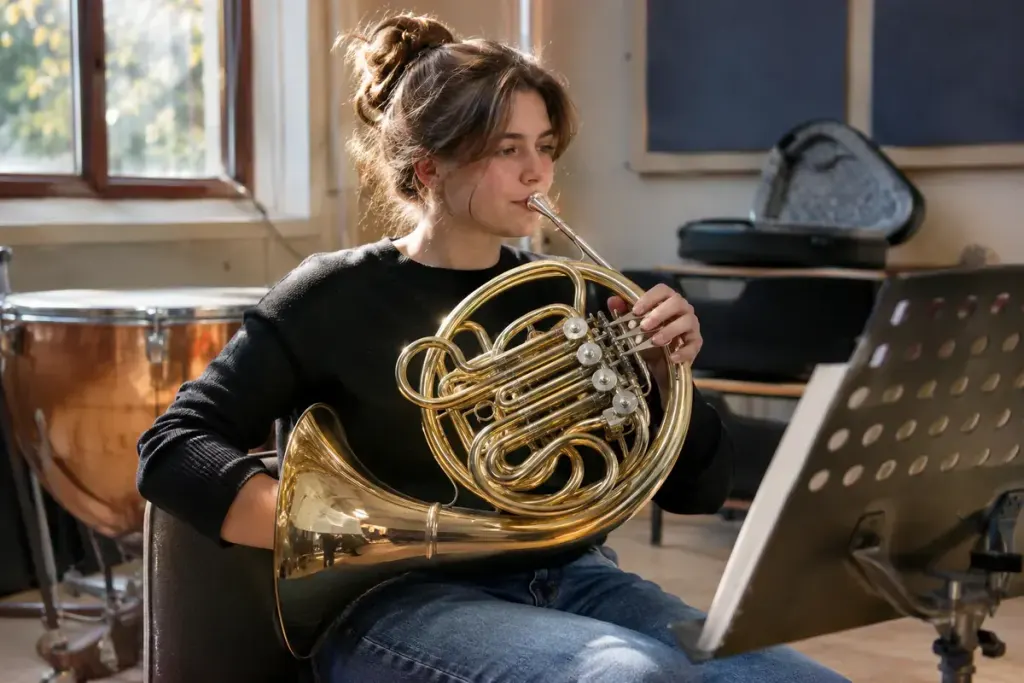
Watch a horn section during an orchestral performance and you may notice a gesture that looks unusual: the players keep a right hand inside the bell. It is part of playing the instrument, not simply a convenient place to support its weight.
Yamaha’s horn guide describes the hand’s role in shaping tone and fine-tuning pitch. The position influences the acoustic behaviour of the instrument, so it belongs in the sound-making process.
Ordinary placement and a stopped sound are different
The hand normally occupies a considered position in the bell. More deliberately closing the opening can create the distinctive effect known as hand-stopping. Yamaha’s explanation of hand-stopping connects the technique with changes in pitch and tone, including its historical use before modern valve arrangements.
Do not assume that every visible movement has the same musical purpose. The player may be adjusting intonation, maintaining position or producing a marked effect within the phrase.
Listen to a short passage twice
On the first hearing, follow the musical line without watching the player. Notice where the colour becomes more muted, bright, distant or forceful. On the second, watch the bell and hand where the camera allows it.
Write the sound observation before the explanation: “the tone becomes more concentrated here” is something you heard; “this must be a stopped note” is a claim that may need the score, a demonstration or a player’s explanation.
Camera direction and recording position can also influence what seems prominent. A concert close-up is useful evidence of a gesture, but it is not a controlled comparison of two hand positions.
If you are learning the instrument, work on the position with a teacher. Small differences depend on the player and horn, and a photograph cannot show the complete relationship between hand shape, airflow and sound.
For an audience member, the reward is a more attentive ear: a familiar orchestral colour becomes the result of several coordinated choices, including one partly hidden inside the bell.