
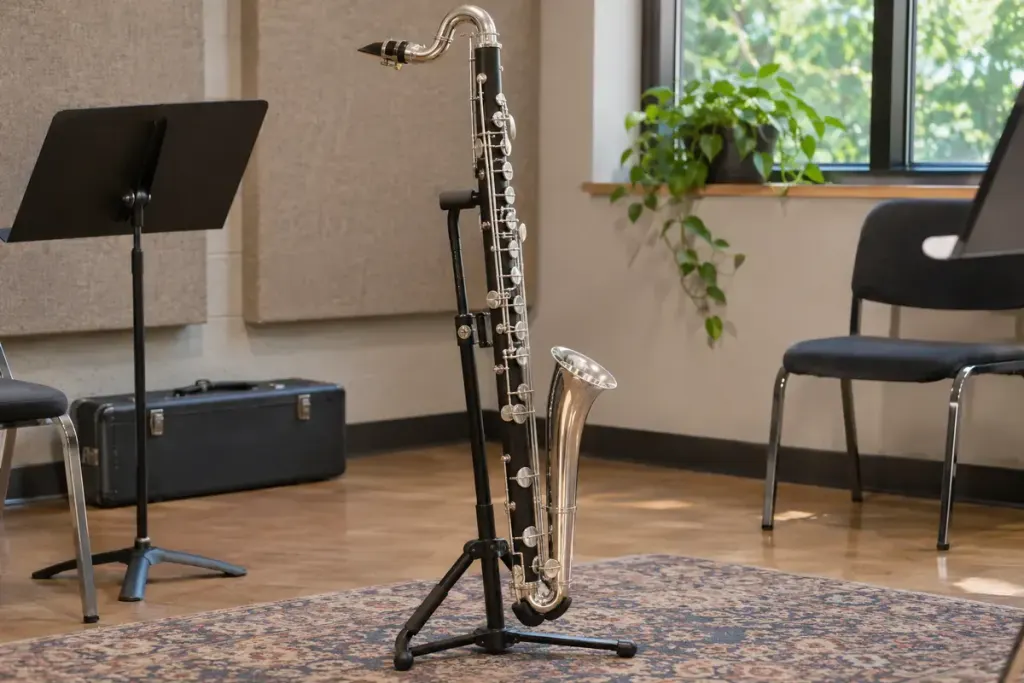
A low woodwind line enters and the ensemble suddenly seems to gain another room. The bass clarinet can provide that depth, but listening only for its lowest notes misses much of what the player is doing.
Yamaha’s guide to the modern clarinet family places the bass clarinet an octave below the B-flat clarinet and describes its use in orchestral music and jazz. Its lower register is an important part of its identity, while its role in a particular piece depends on the writing and performance.
Choose one passage and follow its job
Start with a recording whose credits identify the instrument. Listen once without trying to isolate it. On the second pass, find its entrance and ask what changes: does it reinforce another line, answer a melody or introduce a contrasting colour?
Write a brief description tied to a timestamp. “A sustained low note begins beneath the flute” is more useful than “the music becomes mysterious”. The emotional response is valid, but describing the event lets you return to it and test what produced that response.
Then follow the line when it moves away from the low register. Does the articulation become more prominent? Does the instrument blend with another woodwind or stand apart? Avoid assuming that a change of colour means a different instrument has entered until you have checked the recording or score.
Compare a second performance carefully
If two recordings of the same passage are available, compare the balance and phrasing rather than ranking them by how loudly the bass clarinet is captured. Microphone placement, the room and the rest of the ensemble can affect what reaches you.
At a concert, use the programme’s instrumentation and the visible players as clues, while keeping attention on the sound. You do not need to identify every note to notice a line moving from support into the foreground.
A short listening note can end with a question: was the low line doubling another part, or did it move independently? That question gives the next hearing a purpose and helps the instrument become a voice you recognise rather than a vague layer at the bottom of the texture.