
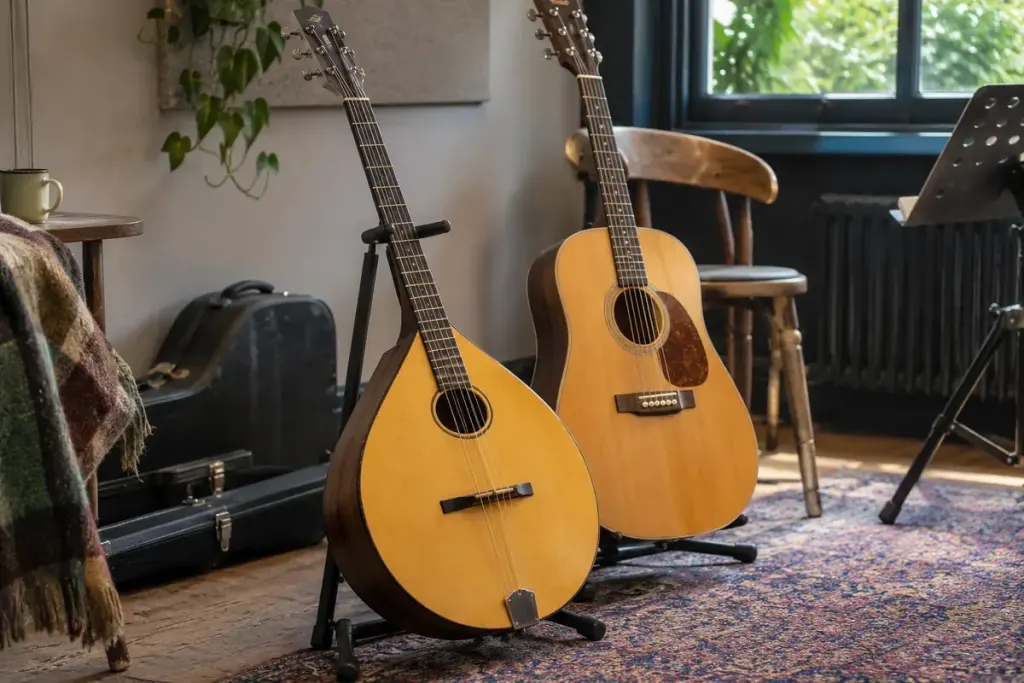
The name bouzouki may bring Greek music to mind, yet an Irish session can give the instrument a different musical role. The Irish bouzouki developed through musicians adapting an instrument and its possibilities to another tradition. Listening for how it supports a tune reveals more than identifying it by its outline.
Paired strings, several possibilities
The Irish Traditional Music Archive’s bouzouki collection offers a route into recorded performances. Compare how players use rhythm, sustained notes, and changes of harmony rather than expecting one standard accompaniment pattern.
Many Irish bouzoukis have four courses of paired strings and a flat-backed body. Tunings and string pairings vary. For example, Gold Tone describes its BZ-1000 with GDAD tuning while acknowledging the instrument’s Greek roots. That model’s specification is an example, not a definition of every Irish bouzouki.
Listen beneath the melody
On a recording with a clear lead instrument, first follow the tune without trying to name chords. On a second listen, concentrate on the bouzouki’s attacks. Does the player reinforce every beat, leave spaces, or create a repeating figure across the phrase? Notice whether ringing strings continue underneath a changing melody.
This listening exercise is useful because accompaniment can change the feeling of the same tune without taking over its main line. A dense strum and a sparse picked pattern may use a similar instrument while producing very different textures.
If you are comparing instruments
Ask about scale length, tuning, string gauges, and whether each pair is in unison or octaves. Try the instrument in the tuning intended for it, or have the maker advise on changes. A photograph cannot tell you how comfortably the neck and string tension will suit your hands.
For a first encounter, a few focused recordings are often more revealing than a shopping list. Hear where the instrument leaves room for other players, then consider which of those sounds you would want to explore yourself.