
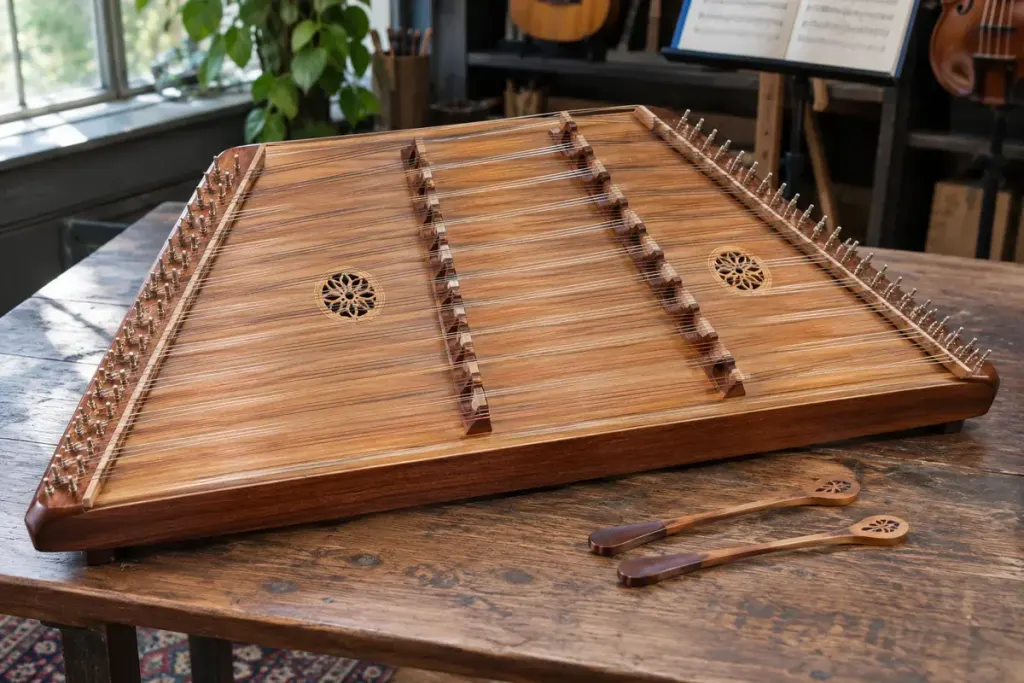
A festival programme lists a dulcimer player. You picture a small instrument resting on someone’s lap, but the performer arrives behind a broad trapezoid of strings with two light beaters. Both expectations can fit the word. The qualifier tells you which instrument family you are about to hear.
The Smithsonian’s hammered-dulcimer feature shows an instrument whose strings are struck with small hammers. A mountain, or Appalachian, dulcimer is a fretted string instrument generally played by plucking or strumming. The National Museum of American History’s collection record offers a separate example of the mountain instrument.
Look at the player’s hands
On a hammered dulcimer, the player directs the beaters toward different courses of strings. Notes can arrive in quick, ringing patterns, with the movement spread across a relatively wide soundboard. On a mountain dulcimer, one hand works along the fretted area while the other excites the strings.
That visible distinction is often more dependable than guessing from a short audio clip. Amplification, arrangement, playing style, and the surrounding ensemble can all change the impression of an instrument’s sound.
A better way to listen at a concert
During the first piece, follow one musical role. Is the instrument carrying the tune, sustaining a drone, outlining chords, or adding a rhythmic pattern? Then notice how the role changes when another musician enters. You do not need to identify every tuning to hear the conversation between parts.
If the programme names only “dulcimer,” the performer’s introduction may supply the missing detail. After the set, a question such as “Was that a hammered dulcimer, and how were you damping the ringing strings?” invites a more useful answer than assuming all dulcimers are played alike.
The shared name is a starting point, not a promise of one shape or sound. Recognising the playing method makes an unfamiliar performance easier to follow without turning the listening experience into a terminology test.