
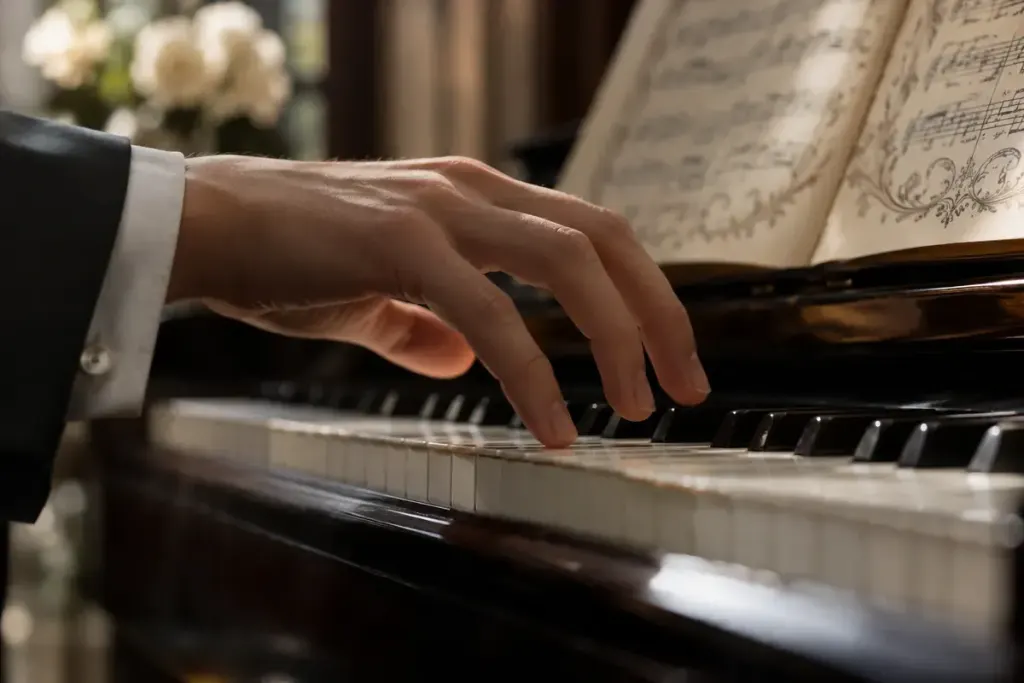
A small note with a slash through its stem can look like a printing accident when you first meet it in a score. It usually signals an acciaccatura: a brief ornamental note connected closely to a principal note.
The symbol does not assign a universal duration such as one thirty-second of a beat. Ornament conventions depend on musical period, style and context. Dolmetsch’s guide to ornaments sets out the notation and the historical distinctions that make a single mechanical rule unreliable.
Listen for the destination
Try following the melody while treating the full-size note as the destination. The small note adds an approach or a moment of friction. If you count it as a completely separate beat every time, you may lose the underlying pulse that gives the phrase its shape.
Now listen to the same short passage twice. On the first hearing, tap only the main pulse. On the second, notice how the ornament sits against it. Does the principal note seem to arrive firmly, or does the ornament briefly lean into its space? Write down what you hear without assuming one recording establishes the only correct interpretation.
Three details to check in the score
- Is the small note slashed, and is there one grace note or a group?
- What does the edition’s ornament guidance say?
- What happens in the accompanying part at that moment?
These questions help distinguish reading the symbol from deciding how to perform it. A modern keyboard exercise, a Baroque edition and a folk arrangement can call for different practical treatment even when the printed marks seem familiar.
For a player, a useful rehearsal step is to practise the principal melody first, then restore the ornament without disrupting the phrase. Ask a teacher about the relevant style if the placement remains unclear. For a listener, the reward is simpler: a tiny mark becomes an audible expressive choice, rather than an extra note to count and forget.