
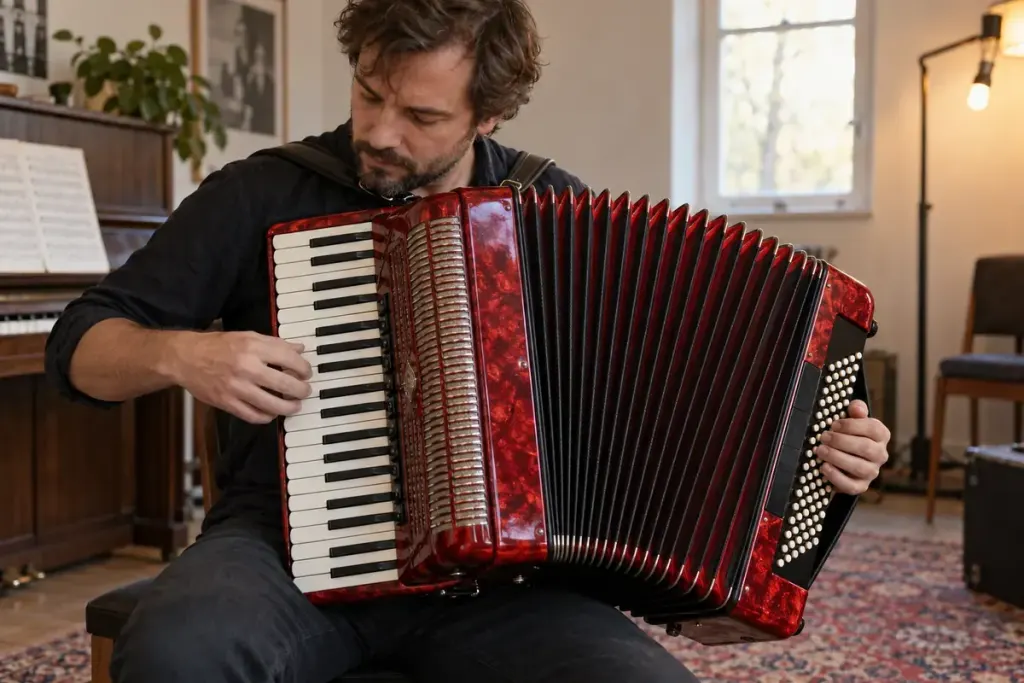
In a close-up of an accordion performance, the keyboard often gets the attention. Move your eyes towards the folding centre of the instrument. The bellows are doing musical work even when the player’s fingers appear to hold the same notes.
Air sets the reeds sounding
An acoustic accordion uses airflow to make metal reeds vibrate. Opening and closing the bellows supplies that flow, while the keys or buttons control the relevant paths. HOHNER’s introduction to accordion components shows the relationship between the bellows, reed block and controls. Its example is one particular instrument, so button layouts should not be assumed identical across all accordions.
The bellows are more than a supply that must simply be kept moving. How the player manages them contributes to the shape of a phrase. Alfred Music’s introductory accordion lesson connects bellows control with dynamics and phrasing. This helps explain why a sustained note can grow or relax without becoming a different note.
Listen once before watching
Choose a short performance with a clear view of the instrument. First listen without trying to name the notes. Notice where the sound seems to gather energy, soften or pause. Then replay the same passage while watching the bellows. Which visible movements accompany the changes you heard?
Do not expect every direction change to announce itself as a dramatic break. Nor should a movement be judged from appearance alone: phrasing, instrument type and the passage being played all matter. A large visible opening is not a universal measurement of loudness.
Try writing one observation with a time reference, such as “the held sound grows during this phrase.” Keep that separate from an explanation you have not verified. The exercise is closer listening, not an attempt to grade a musician’s technique from a camera angle.
Digital accordions may use sensors and electronic sound generation rather than the acoustic reed process described here. For an acoustic performance, however, following the bellows gives you another way into the music: the hands select and articulate notes, while the moving air helps give those notes their expressive shape.