
You Can Visit Gozo in One Day, But Are You Leaving Just When the Island Starts to Feel Different?
Sundown Malta >> Travel Tips>> You Can Visit Gozo in One Day, But Are You Leaving Just When the Island Starts to Feel Different?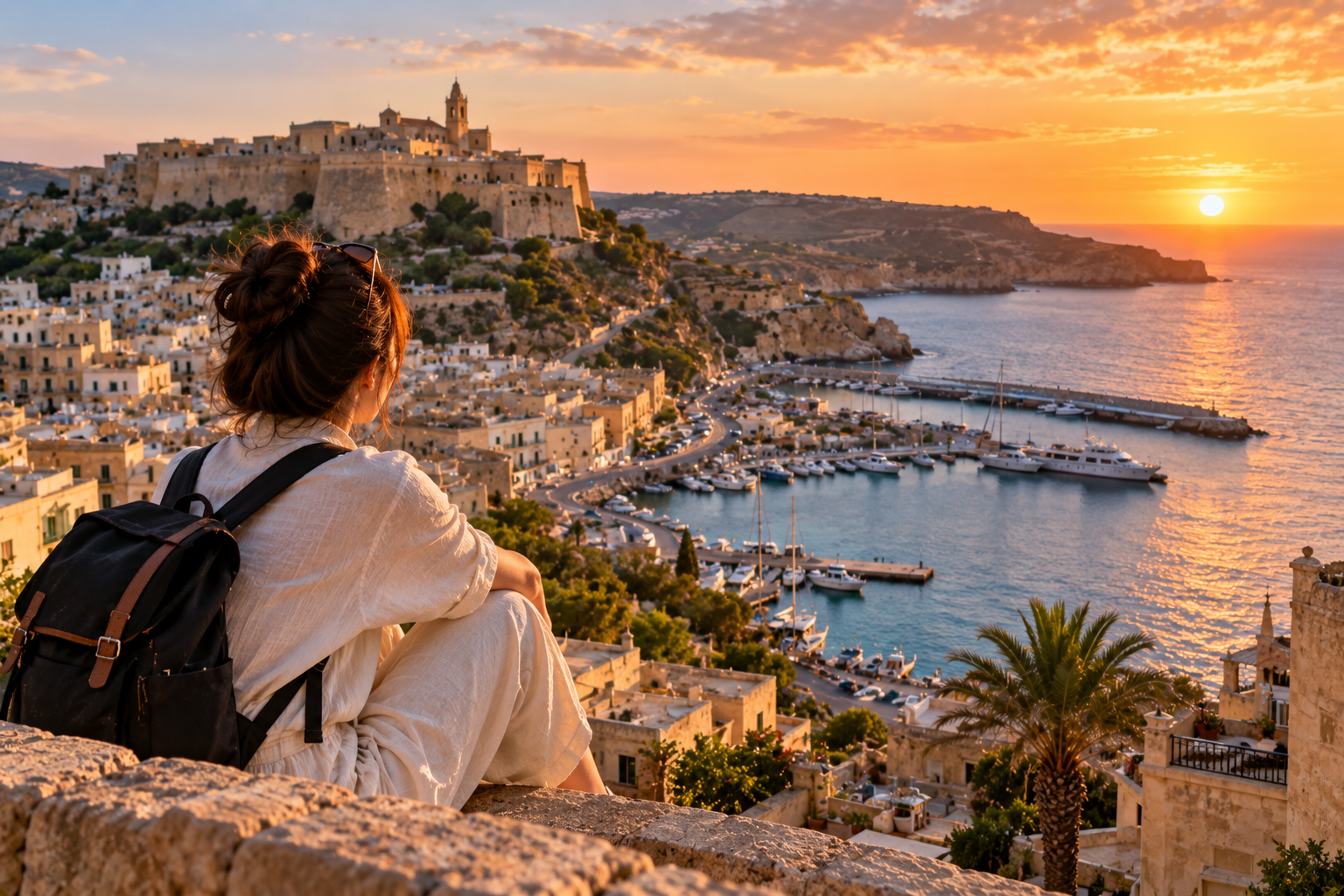
You Can Visit Gozo in One Day, But Are You Leaving Just When the Island Starts to Feel Different?
Gozo looks easy on a Malta itinerary.
The island is small.
The ferry crossing is short.
You can leave Malta in the morning, spend several hours exploring, and return before dinner.
So naturally, many first-time visitors treat Gozo as a day trip.
Arrive.
See the Citadel.
Visit a dramatic stretch of coastline.
Stop at a beach.
Take some photos.
Head back to the ferry.
Technically, it works.
You have been to Gozo.
But there is a difference between seeing the island’s major sights and experiencing the rhythm of the island itself.
That difference becomes especially noticeable when afternoon visitors begin heading back toward Malta.
Roads become quieter.
Popular stops lose some of their daytime movement.
Dinner no longer needs to compete with the ferry schedule.
And instead of calculating how much time remains before you need to leave, you can simply stay.
This is why travelers with enough time should at least consider whether to stay overnight in Gozo rather than automatically treating the island as a one-day excursion.
The right answer depends on the length of your Malta trip, what you want to see, and how quickly you like to travel.
Gozo Is Absolutely Possible as a Day Trip
First, there is nothing wrong with visiting Gozo for one day.
For a short Malta holiday, it can be the most practical choice.
The main ferry crossing between Ċirkewwa and Mġarr is short, and Gozo is compact enough that several major places can be combined into a single day.
With efficient transportation, you can experience a meaningful introduction to the island.
You might explore Victoria and the Citadel.
Continue toward Dwejra.
Visit a coastal village.
Stop at Ramla Bay.
Then return to Mġarr for the ferry.
For someone with only three or four days in Malta, this may be exactly the right compromise.
The problem begins when a day trip is treated as the only reasonable way to experience Gozo.
It isn’t.
One Day Changes the Way You Travel
A day trip has an invisible deadline.
From the moment you arrive, you know you are leaving again.
That changes decisions throughout the day.
Should we stop here?
How long can lunch take?
Can we swim?
Do we have time for another village?
How far are we from the ferry?
The island becomes something you need to complete.
Staying overnight removes that pressure.
Suddenly, reaching the final attraction before a certain hour matters less.
You can change the route.
Skip something.
Stay longer somewhere unexpectedly beautiful.
Have dinner without thinking about transportation back to Malta.
That flexibility is often more valuable than adding another attraction.
The Ferry Crossing Is Short—But Getting to the Ferry Takes Time Too
When planning a Gozo day trip, people often focus only on the actual crossing.
But your real travel time begins wherever you are staying in Malta.
If your accommodation is nowhere near the departure point, you first need to reach the ferry.
Then there may be waiting time.
Then the crossing.
Then transportation after arriving at Mġarr.
At the end of the day, the process happens in reverse.
None of these steps is necessarily difficult.
But together they consume part of the day.
That matters when deciding whether a one-day visit gives you the experience you actually want.
A Day Trip Rewards Prioritization
If you only have one day, accept that you probably should not try to see everything.
Choose a few priorities.
Maybe history matters most.
Start with Victoria and the Citadel.
Maybe you came for scenery.
Prioritize Dwejra and coastal viewpoints.
Maybe swimming is the reason you wanted Gozo.
Give yourself enough time at a beach rather than spending the entire day moving between stops.
A successful Gozo day trip is selective.
Trying to visit every famous location can turn a beautiful island into a sequence of parking lots and rushed photographs.
Gozo Looks Small on a Map
This creates another planning trap.
The distances appear tiny.
And geographically, they are.
But travel time is not only about distance.
You still need to navigate village roads.
Park.
Wait for buses or taxis.
Walk to viewpoints.
Stop for food.
Find entrances.
Return to your vehicle.
A location twenty minutes away can easily consume an hour once the entire stop is included.
Four or five stops later, the day disappears surprisingly quickly.
Public Transportation Changes the Equation
Travelers with a rental car, private driver, or organized tour can generally move between scattered locations more efficiently.
Travelers relying on buses need to think differently.
Public transportation can work, but you are traveling according to routes and schedules rather than your own pace.
That does not make a Gozo day trip impossible.
It simply means your itinerary should become less ambitious.
If transportation already consumes part of the day, trying to squeeze in another attraction may not improve the experience.
Staying Overnight Makes Inefficiency Less Important
Miss a bus?
Lunch takes longer?
You find a beautiful viewpoint and stay for another forty minutes?
No problem.
You are not trying to catch a return crossing immediately after sunset.
This is one of the simplest reasons to stay overnight in Gozo.
You gain margin.
Travel becomes less fragile.
A small delay no longer forces you to remove the next stop.
That creates a noticeably different mood.
One Night Gives You Two Partial Days
This is the useful part people sometimes overlook.
Staying one night does not merely give you an evening.
It changes two days.
You can arrive on Gozo around midday on the first day.
Explore during the afternoon.
Watch sunset.
Have dinner.
Sleep on the island.
Then start again the following morning before returning to Malta later.
Instead of forcing everything between morning arrival and evening departure, your sightseeing is distributed across a much wider window.
Sunset Becomes an Activity Instead of a Deadline
Gozo has the kind of landscape that makes evening worth protecting.
Coastline.
Cliffs.
Open countryside.
Stone villages.
Small bays.
Golden limestone becomes particularly atmospheric as daylight softens.
On a day trip, sunset can create a scheduling problem.
You may want to stay.
But you also need to consider your journey back.
When you sleep on Gozo, there is nowhere else you need to be.
Watch the light change.
Then go to dinner.
That simple sequence can become one of the most memorable parts of the trip.
The Island Feels Different After Day Visitors Leave
Popular destinations often have two personalities.
There is the daytime version shaped partly by visitors.
Then there is the quieter version after excursion traffic decreases.
Gozo is no exception.
Staying overnight gives you access to both.
You may spend the afternoon around well-known sights, then find yourself walking through a much calmer village later that evening.
The buildings have not changed.
The atmosphere has.
Sometimes that is exactly what makes an overnight stay worthwhile.
Victoria Deserves More Than a Quick Stop
Victoria, also known as Rabat, is the center of Gozo and a natural part of most itineraries.
Day visitors often head directly toward the Citadel, explore it, and continue elsewhere.
That makes sense when time is limited.
But staying longer allows Victoria to function as more than an attraction.
Walk around.
Stop for coffee.
Explore side streets.
Have dinner.
Return to the Citadel area under different light.
A place becomes more interesting when you stop treating it solely as something to complete.
Villages Make More Sense at a Slower Pace
Some destinations impress immediately.
A giant monument.
A dramatic viewpoint.
A famous beach.
Villages can work differently.
Their appeal may come from small details.
Balconies.
Church squares.
Quiet streets.
Local bakeries.
Stone houses.
People gathering in the evening.
You cannot always schedule that experience into a fifteen-minute stop.
Time creates context.
That is where a slower Gozo itinerary begins to separate itself from a sightseeing tour.
Staying Overnight Does Not Mean You Need a Luxury Hotel
The point is not necessarily the accommodation itself.
You simply need a comfortable base.
Gozo offers different styles of stays, from hotels and guesthouses to apartments and traditional-style farmhouse accommodation.
Choose based on your itinerary and transportation.
If you will not have a car, accessibility matters.
If you want quiet countryside, a rural location may be appealing.
If restaurants and transportation convenience matter more, staying closer to a town may make life easier.
Do not choose accommodation only because it looks beautiful in photographs.
Think about how you will actually use it.
Location Matters More When You Only Have One Night
If you are staying for a week, a slightly inconvenient accommodation can be manageable.
For one night, every unnecessary transfer consumes a larger percentage of the trip.
Look at your route before booking.
Where will you arrive?
What do you want to see?
Where will you eat?
How will you return to the ferry?
A strategically located room can make a short overnight visit feel surprisingly relaxed.
A poorly located one can create extra transportation.
Do Not Change Hotels Just for the Sake of Saying You Stayed on Gozo
There is another side to this.
Moving accommodation creates work.
Packing.
Checking out.
Transporting luggage.
Checking in again.
Then repeating the process when returning to Malta.
If your entire holiday is only three days, that disruption may not be worthwhile.
This is why stay overnight in Gozo should not become a universal rule.
It is an option.
Evaluate the trade-off.
For a short trip, a day visit can preserve simplicity.
For a longer trip, the overnight experience becomes easier to justify.
Five or More Days Gives You More Flexibility
Once your Malta holiday becomes longer, allocating a night or two to Gozo becomes much easier.
You are no longer sacrificing a huge portion of the main island.
There is room to divide the trip.
Malta first.
Gozo later.
Or Gozo in the middle.
The exact structure depends on your flights, accommodation, transportation, and priorities.
But longer trips allow the islands to be experienced as separate environments rather than treating Gozo as an attraction attached to Malta.
Two Nights Changes the Experience Again
One night removes much of the rush.
Two nights begins to create a genuine stay.
Now you have at least one day where you wake up on Gozo and do not immediately need to leave.
That means breakfast can be slow.
The itinerary can respond to weather.
A beach stop can become an afternoon.
A long lunch no longer feels irresponsible.
You can explore one part of the island today and another tomorrow.
The experience becomes less about efficiency.
Three Nights Is for Travelers Who Actually Want Gozo
At three nights, Gozo is no longer a side trip.
It becomes one of the main destinations.
This works particularly well for travelers interested in:
Coastal walks.
Swimming.
Diving.
Countryside.
Historic sites.
Photography.
Food.
Quiet evenings.
Or simply a slower pace.
If your travel style is built around constant nightlife, dense urban exploration, and checking many major attractions every day, you may not need that much time.
But if Gozo’s atmosphere is part of the attraction, extra nights are not wasted.
Do Not Spend the Extra Night Doing Twice as Many Things
This defeats the purpose.
You decide to stay overnight.
Great.
Then you add six more attractions because there is now more time.
Suddenly the itinerary is just as rushed as before.
Use some of the additional time as margin.
Choose fewer stops.
Allow longer meals.
Walk without an objective.
Return somewhere you liked.
The value of extra time is not only the ability to do more.
It is also the ability to hurry less.
Dwejra Is a Good Example
A dramatic coastal location can easily become a quick itinerary stop.
Arrive.
Look around.
Take photos.
Leave.
But landscapes reward time.
Clouds change.
Light changes.
The sea changes.
You notice details you missed during the first five minutes.
When the itinerary is not compressed into one day, places like this stop functioning purely as photo opportunities.
You can actually be there.
Ramla Bay Does Not Need to Be a Ten-Minute Photo Stop
Beaches are another good example.
A day-trip itinerary might list:
Ramla Bay — 30 minutes.
Technically, you saw it.
But beaches are places designed for time.
Swimming.
Sitting.
Walking.
Reading.
Doing nothing.
If you want that experience, schedule accordingly.
There is little value in adding a beach to an itinerary if you spend more time parking and changing clothes than enjoying the water.
Separate Sightseeing Days From Beach Time When Possible
Trying to combine historical attractions, villages, long lunches, swimming, coastal walks, and sunset into one day creates constant switching.
With an overnight stay, divide the rhythm.
Maybe the first afternoon focuses on history and villages.
The next morning is for the coast.
Or reverse it based on weather.
This reduces the feeling that every stop is competing with the next one.
Weather Matters More Than Your Spreadsheet
Island travel is influenced by weather.
Wind can change sea conditions.
Clouds can change beach plans.
Summer heat can make walking less appealing during the middle of the day.
A rigid one-day itinerary has little room to adapt.
An overnight stay gives you another window.
If the afternoon is unpleasant, perhaps tomorrow morning works better.
Flexibility becomes especially valuable when outdoor experiences are a major reason for visiting.
Summer Requires a Different Pace
Hot weather can make an itinerary that looked easy at home feel exhausting.
Walking through exposed areas at midday.
Waiting for transportation.
Climbing.
Carrying water.
Moving repeatedly between stops.
In warmer months, slowing down can improve the experience dramatically.
Start earlier.
Take a longer lunch.
Swim.
Rest during the hottest period.
Explore again later.
Staying overnight makes this rhythm much easier than trying to complete the island in a single continuous push.
Shoulder Season Can Reward Walkers
Outside peak summer heat, Gozo can appeal strongly to travelers interested in walking and countryside.
Now the journey is not only about beaches.
Paths.
Cliffs.
Fields.
Villages.
Coastal landscapes.
These activities naturally require time.
A walk cannot always be compressed without losing the reason you wanted to do it.
If hiking or photography matters, consider allocating enough time to stop treating transportation as the main event.
Your Transportation Choice Should Follow Your Itinerary
Do not automatically rent a car because someone said it is essential.
And do not automatically rely on public transportation because the island is small.
Start with your plan.
If you want to reach several scattered locations in a short period, independent transportation can make the day much easier.
If you are staying longer and moving slowly, buses and occasional taxis may be perfectly workable.
If you prefer not to plan logistics, an organized excursion may suit you better.
The best transportation method is the one that supports your travel style.
A Rental Car Creates Freedom—and Responsibility
Having a car allows spontaneous changes.
You can stop at viewpoints.
Move between villages efficiently.
Carry swimming gear.
Leave when you want.
But driving also means navigating unfamiliar roads, finding parking, and understanding local driving conditions.
That trade-off is worth considering.
Freedom is valuable only if driving does not make you more stressed.
Tours Solve a Different Problem
Organized tours can be excellent for travelers who want to see several highlights without planning every transfer.
Someone else handles the route.
You follow the schedule.
This can make a one-day visit much easier.
The trade-off is flexibility.
If you love a particular location, you may still need to leave when the group leaves.
Tours optimize logistics.
Independent travel optimizes control.
Neither is automatically better.
Pack Differently for an Overnight Stay
You do not necessarily need to move your entire suitcase.
If you are returning to the same accommodation in Malta and your booking arrangement allows luggage storage, a small overnight bag may be enough.
Bring essentials.
A change of clothes.
Basic toiletries.
Swimwear if relevant.
Charging equipment.
Medication.
Anything needed for the following morning.
Traveling light makes the overnight transition much easier.
But Check Your Accommodation Arrangement First
Do not assume your Malta hotel will store luggage overnight for free.
Policies differ.
Ask beforehand.
Sometimes keeping the Malta room while spending one night elsewhere may even make sense for travelers who prioritize convenience over cost.
Other travelers will prefer checking out completely.
There is no universal answer.
Calculate what matters more to you: money, convenience, or minimizing packing.
Do Not Book the Return Too Tightly Around Your Flight
If Gozo is the final part of the trip, build sensible margin before an important flight.
You are crossing between islands and then continuing toward the airport.
Transport systems are generally manageable, but important departure days should not depend on multiple connections working with zero delay.
A relaxed final night near your departure route may be worth more than squeezing one additional morning from Gozo.
Early Morning Is One of the Hidden Benefits
Travelers often discuss Gozo at sunset.
Morning deserves equal attention.
When you wake up on the island, you can begin before most day visitors arrive.
That can make popular locations feel completely different.
The air may be cooler.
Roads quieter.
Photography easier.
And psychologically, you are not starting the day with a journey just to reach the destination.
You are already there.
Breakfast Without a Departure Rush Changes the Day
Small moments matter.
Instead of checking transport while eating, you can sit down.
Have coffee.
Look at the weather.
Decide what makes sense.
Maybe you change the order of the day.
That freedom sounds minor until you compare it with an itinerary where every hour has already been assigned.
Travel becomes more enjoyable when plans can respond to reality.
Food Is Easier to Enjoy When You Are Not Watching the Clock
Long meals and day trips are natural enemies.
You sit down.
The menu looks good.
Then someone checks the time.
“We need to leave in forty minutes.”
Staying overnight removes that tension from dinner.
You can explore local food as an experience rather than a refueling stop between attractions.
For travelers who care about food, this alone can justify a slower itinerary.
Evening Is Not Just “More Sightseeing”
You do not need another attraction after dinner.
Walk.
Sit somewhere.
Have a drink.
Return to your accommodation.
Listen to a village settle down.
Travel memories are often created during these unscheduled periods.
They rarely appear in itinerary templates because there is nothing specific to list.
But that does not make them empty time.
Avoid Treating Gozo as “Mini Malta”
Gozo is closely connected to Malta, but visiting it only to find smaller versions of things you already saw misses part of the appeal.
Its scale and rhythm are different.
The landscape feels more rural in many areas.
Settlements are smaller.
The relationship between countryside and village life is more visible.
That difference is easier to appreciate when you stop comparing attraction counts and simply spend time there.
Comino Should Not Automatically Be Added to the Same Day
Malta itinerary planning often produces one tempting sentence:
“Gozo + Comino day trip.”
It is certainly possible through various excursions.
But ask what experience you want.
If the goal is seeing multiple islands efficiently, combining them can work.
If the goal is understanding Gozo, splitting limited time between another island reduces the hours available.
Adding destinations does not automatically add depth.
One Excellent Day Is Better Than Three Rushed Islands
This principle applies throughout Malta.
A travel day does not need to maximize geography.
It needs to create an experience you actually enjoy.
If your ideal day involves swimming and a boat trip, prioritize that.
If you love history, give historical places enough time.
If Gozo itself is the priority, allow it to be the destination rather than one component of an island checklist.
Decide Based on the Length of Your Entire Malta Trip
A useful way to make the decision is to stop asking:
“How many days does Gozo deserve?”
Instead ask:
“How should I divide the time I actually have?”
If your entire Malta trip is very short, a day trip can make excellent sense.
With a medium-length trip, one night becomes attractive.
With a week or more, two or more nights become easier to justify if Gozo matches your interests.
Context matters.
Decide Based on Your Travel Personality Too
Some travelers become restless after one slow afternoon.
Others become exhausted by changing locations every day.
Neither is wrong.
If you love rapid sightseeing, a well-organized day trip may leave you satisfied.
If your favorite travel memories involve wandering, long meals, sunsets, and unexpected discoveries, staying overnight will probably fit your style better.
Build the itinerary for the person actually taking the trip.
Not for the person who created the longest Google Maps list.
Do Not Let FOMO Design the Trip
Fear of missing out creates terrible itineraries.
You hear about another beach.
Add it.
Another church.
Add it.
Another village.
Add it.
Soon you are spending more time getting somewhere than being anywhere.
Gozo is small enough to tempt you into believing everything can fit.
Resist that temptation.
Leaving something unseen gives you a reason to return.
Your Best Gozo Memory May Not Be a Famous Attraction
Maybe it is the Citadel.
Maybe Dwejra.
Maybe Ramla Bay.
But it could also be:
A quiet dinner.
A village square.
A coastal road.
Morning coffee.
A random viewpoint.
A conversation.
A sunset you stayed twenty minutes longer to watch.
These experiences require availability more than planning.
An overnight stay creates that availability.
When a Day Trip Is the Better Choice
Stay based in Malta and visit Gozo for the day when your trip is short, you dislike changing hotels, or you mainly want to see a few highlights.
Start early.
Choose priorities.
Keep the route geographically sensible.
Do not attempt every famous stop.
And leave enough margin to enjoy the places you do choose.
A focused day trip can be much better than a badly organized overnight visit.
When You Should Consider Staying Overnight
Consider an overnight stay when Gozo is one of the places you are genuinely excited about.
It becomes particularly worthwhile if you want slower evenings, sunrise or early-morning exploration, coastal walks, beach time, photography, or a less scheduled experience.
One night already changes the rhythm.
Two nights changes it significantly.
The important thing is using the extra time to slow down rather than simply expanding the checklist.
Conclusion
You can visit Gozo in a day.
For travelers with limited time in Malta, that may be exactly the right decision.
A carefully planned day trip can include history, coastline, villages, and a taste of the island’s character without requiring another hotel.
But if your schedule has room, there is a strong reason to stay overnight in Gozo.
The benefit is not simply having more hours to collect more attractions.
It is having fewer deadlines.
You can watch sunset without immediately thinking about leaving. You can have dinner without rushing. You can wake up already on the island and begin the next morning before the day-trip rhythm takes over.
Most importantly, you gain time to experience Gozo between the famous stops.
That may mean a village street.
A long lunch.
A quiet coastline.
Or an evening where nothing particularly important happens.
And sometimes that is exactly when a destination stops feeling like somewhere you visited—and starts feeling like somewhere you actually experienced.
Related Post

Malta Looks Tiny on the Map—So Why Does Getting Around Take Longer Than You Expect?
You open the map. Malta looks tiny. Really tiny. Valletta to Mdina? Doesn't look far.…