Maltese Balconies: Why These Colourful Gallariji Define Malta’s Streets
Sundown Malta >> Culture>> Maltese Balconies: Why These Colourful Gallariji Define Malta’s Streets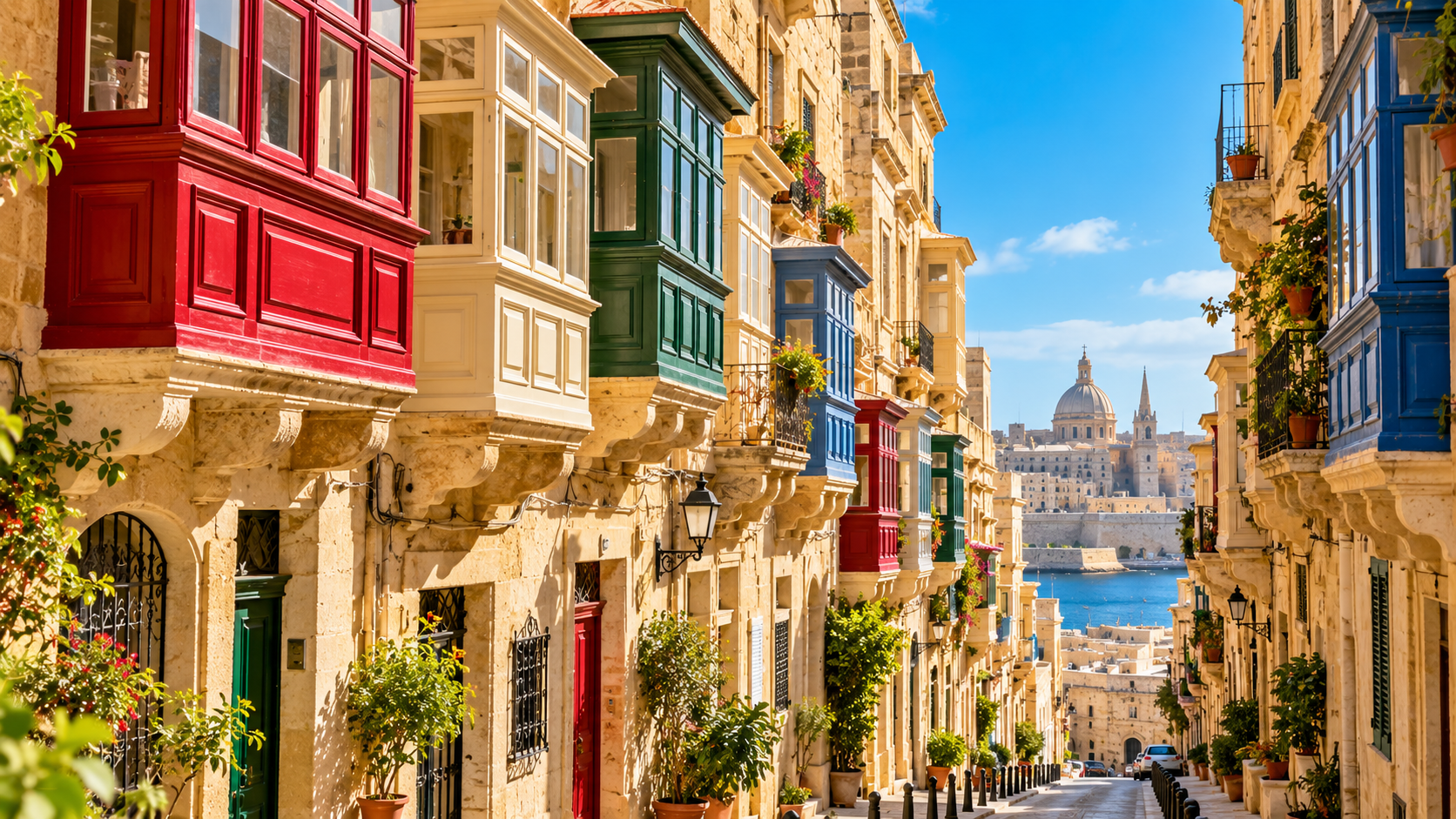
Maltese Balconies: Why These Colourful Gallariji Define Malta’s Streets
Walk through an old Maltese street and the buildings can seem surprisingly simple at first.
Warm limestone walls rise closely beside narrow roads. Doorways sit only a few steps from the pavement. Shutters break up otherwise pale façades, while streets twist between churches, small squares, shops, and tightly packed homes.
Then you look upward.
Green, blue, red, burgundy, and other painted wooden structures project from the upper floors.
These enclosed Maltese balconies are known as gallariji, and they have become one of the most recognizable features of Malta’s traditional urban landscape.
Visitors naturally photograph them because they are beautiful. However, treating the gallarija as decoration alone misses much of what makes it interesting.
Its enclosed form responds to the street, climate, household, and way Maltese towns developed. It creates extra usable space while allowing light and ventilation into buildings that often stand directly beside narrow streets.
More importantly, it changes the experience of walking through Malta.
Once you begin noticing these balconies, an ordinary walk through an old neighborhood becomes an architectural treasure hunt.
What Are Maltese Balconies?
The traditional gallarija is an enclosed projecting balcony attached to the upper level of a building.
Unlike an open balcony with a railing, the classic wooden gallarija resembles a small room extending beyond the façade.
Windows usually cover much of its exterior.
Wooden panels form the lower section.
The structure projects over the street and is commonly supported beneath by stone or structural elements integrated into the building.
Because it is enclosed, the gallarija feels like an extension of the interior rather than simply an outdoor platform.
That distinction explains much of its character.
You can be physically inside the house while remaining visually connected to the street outside.
Why Maltese Balconies Stand Out So Easily
Malta’s traditional building material creates the perfect visual background.
Many historic buildings use pale limestone.
The stone can appear honey-colored under strong sunlight and warmer still near sunset.
Against that relatively consistent background, painted timber immediately attracts attention.
A deep green balcony becomes dramatically visible.
So does burgundy.
Blue.
Muted red.
White.
Natural timber.
When several neighboring houses use different balcony colors, the street develops a rhythm without needing elaborate decoration across every surface.
The contrast does much of the visual work.
The Gallarija Is More Than a Pretty Façade
Visitors encounter the balcony from outside.
Residents historically experienced it from inside.
Those are two completely different perspectives.
From the street, it creates color, depth, shadow, and architectural character.
From inside, however, the gallarija becomes usable household space.
It provides a place from which someone can observe activity below while remaining sheltered.
Windows can allow airflow.
The enclosure offers shade.
Depending on its orientation and design, it can create a buffer between the interior room and the weather outside.
This practical side is essential to understanding why the feature became so integrated into Maltese architecture.
Architecture Makes More Sense When You Think About Climate
Malta receives strong Mediterranean sunlight.
Historic streets can also be narrow and densely built.
That combination creates interesting architectural challenges.
Homes need light.
They need ventilation.
At the same time, intense direct sunlight can increase heat.
An enclosed projecting balcony can help mediate between those conditions.
Windows allow controlled exposure to outside air and light, while the structure itself creates shade.
Instead of separating the house completely from the street, the gallarija creates an intermediate space.
It is neither completely outside nor simply another conventional interior room.
The Balcony Creates a Connection With Street Life
Imagine living above a narrow street before televisions, smartphones, or air conditioning transformed daily routines.
Activity outside mattered.
Neighbors passed beneath the window.
Vendors moved through the street.
Children played nearby.
Church bells marked time.
Religious processions occasionally passed.
People traveled between homes and shops.
A projecting balcony offered a broader view of that activity than a flat window.
Someone could observe what was happening without necessarily stepping outside.
That makes the gallarija both architectural and social.
Why Enclosed Balconies Work So Well on Narrow Streets
A normal flat window gives you a relatively direct view outward.
A projecting balcony creates additional viewing angles.
Its side windows allow someone to look along the street rather than only across it.
That matters when buildings stand close together.
From inside the balcony, you can potentially see approaching activity before it reaches the front of the house.
The design effectively pushes the viewing position beyond the wall.
For a visitor walking below, the same projection creates depth along the façade.
Shadows Are Part of the Design
Architecture is not only about physical objects.
It is also about how those objects interact with light.
A projecting gallarija creates shadows beneath and around itself.
As the sun moves, those shadows shift.
Wooden frames create smaller patterns across windows.
Stone supports introduce another layer of depth.
This is one reason old Maltese streets can look particularly dramatic during lower-angle morning or evening light.
The façade becomes more three-dimensional.
Why Are Maltese Balconies So Colourful?
There is no need to invent a secret code behind every balcony color.
Much of the appeal comes from individual buildings introducing color against Malta’s limestone streetscape.
Green is especially strongly associated with the traditional visual identity, but it is far from the only color visitors encounter.
Look around carefully and you may find variations of blue, red, burgundy, yellow, white, brown, and other shades.
The interesting part is not discovering one universal meaning behind each color.
It is seeing how individual choices collectively create the character of a street.
Green Has Become Particularly Iconic
Ask someone to imagine a classic Maltese gallarija and there is a good chance they picture a green one.
Deep green timber contrasts beautifully with limestone.
It feels traditional without disappearing into the façade.
However, limiting your attention to green balconies means missing much of the variety.
Once you start exploring older neighborhoods, differences become part of the experience.
Two streets only minutes apart can have noticeably different combinations.
Look Beyond the Balcony Color
Color is the easiest feature to notice.
It is not the only one.
Look at the proportions.
Some balconies are compact.
Others stretch across a significant portion of the façade.
Some wrap around building corners.
Window arrangements differ.
Decorative wooden details vary.
Stone supports beneath them can be simple or elaborate.
Nearby doors and shutters may match the balcony or use contrasting colors.
The more slowly you walk, the more variation becomes visible.
Corner Balconies Are Especially Interesting
A corner changes what a balcony can do.
Instead of projecting from a flat façade, a corner gallarija can visually connect two sides of a building.
That makes it more prominent from the street.
It can also create broader viewing angles from inside.
For photographers, corner examples are particularly useful because they reveal the three-dimensional form more clearly.
You can see how the balcony projects beyond the stone walls rather than reading it as a flat decorative feature.
Where Can You See Maltese Balconies?
You do not need to hunt for one famous balcony.
That is part of their appeal.
Traditional balconies appear across historic areas of Malta and Gozo.
Valletta provides countless opportunities because its streets combine dense architecture, dramatic slopes, and long sightlines.
However, limiting your search to Valletta would be a mistake.
Older neighborhoods and town centers elsewhere can be equally rewarding.
Valletta Makes the Balcony Impossible to Ignore
Valletta is an obvious starting point.
Its grid-like streets create long architectural views.
Walk downhill and you may see rows of projecting balconies stacked visually against distant glimpses of the harbor or sea.
Walk across the grid instead, and the view changes.
Now individual façades become more prominent.
The combination of stone, shutters, doors, balconies, churches, and sloping streets gives the city its distinctive texture.
Yet one of the best ways to experience Valletta is not to chase landmarks continuously.
Walk.
Look upward.
Turn into smaller streets.
Do Not Only Walk the Main Streets
Major pedestrian routes are useful for orientation.
They are also busy.
If you want to notice architectural details, move away from the busiest path occasionally.
Parallel streets can feel completely different.
A quieter lane may give you more time to examine a façade.
There may be fewer storefront signs competing for attention.
Laundry, plants, shutters, doorways, and balconies reveal that these historic buildings are not merely scenery.
Many remain part of everyday urban life.
The Three Cities Offer Another Perspective
Across the Grand Harbour, the historic urban environment continues.
Birgu, Senglea, and Cospicua offer streets where balconies sit within a different rhythm from central Valletta.
Some areas feel more residential.
Street widths change.
Harbor views appear unexpectedly between buildings.
Staircases and slopes alter perspective.
Instead of approaching these places as a checklist of monuments, allow time simply to wander.
Architecture often becomes most memorable between the official attractions.
Mdina Changes the Mood Again
Mdina offers another type of historical atmosphere.
The fortified city is quieter than central Valletta at many times of day, especially when visitor traffic thins.
Its architecture can feel more restrained and monumental.
Here, balconies become part of a broader composition of stone walls, heavy doors, narrow passages, religious architecture, and enclosed courtyards.
The experience demonstrates an important point:
A gallarija does not look identical in every setting.
Its surroundings shape how you perceive it.
Rabat Rewards Slow Walking
Rabat is another place where everyday streets and historical architecture overlap.
Visitors sometimes treat it mainly as an extension of a trip to Mdina.
That can make them move too quickly.
Walking through residential streets reveals architectural details that are easy to miss when traveling only between major attractions.
Balconies become part of living neighborhoods rather than isolated heritage objects.
That context matters.
Gozo Has Its Own Architectural Rhythm
Crossing to Gozo changes the pace.
Village centers, rural surroundings, churches, farmhouses, and smaller-scale streets create a different visual experience.
Traditional balconies still appear, but they exist within another landscape.
A balcony overlooking a quiet Gozitan village street does not feel exactly like one projecting above central Valletta.
The architectural language is related.
The atmosphere is different.
That contrast is worth noticing.
Look Up When Walking Through Village Centers
Travelers naturally look forward.
Maps encourage it.
Navigation apps encourage it.
Signs encourage it.
Architecture often rewards the opposite habit.
Look above street level.
Balconies.
Cornices.
Religious niches.
Shutters.
Stone carvings.
Rooflines.
Old signs.
Weathered surfaces.
A significant part of Malta’s visual character exists above normal eye level.
Maltese Balconies Reward Walking Instead of Driving
You can notice balconies from a vehicle.
You cannot really study them.
Walking lets you stop.
Cross the street.
Change your viewing angle.
Notice the balcony’s side panels.
See the supports beneath it.
Compare neighboring houses.
Watch how light changes the color.
Architecture becomes an experience rather than background scenery.
For this reason, old town centers are best explored slowly whenever practical.
Morning Light Changes the Streets
Early daylight can make limestone appear soft and pale.
Streets may also be quieter.
That creates a good environment for architectural exploration.
Balconies catch directional light without the harsh contrast that develops later on bright days.
Morning is particularly useful if you want photographs with fewer pedestrians and vehicles.
However, remember that these are real neighborhoods.
Quiet exploration should remain respectful.
Late Afternoon Can Be Even More Dramatic
As the sun lowers, Malta’s stone can become remarkably warm.
Golden light intensifies the contrast between limestone and painted wood.
Longer shadows emphasize projecting balconies.
A street that looked relatively flat at midday can suddenly develop depth.
This is one reason wandering before sunset can be rewarding even if you have already explored the same neighborhood earlier.
The architecture has not changed.
The light has.
Midday Is Not Necessarily Bad
Travel photography advice often treats midday as something to avoid.
That is too simple.
Strong overhead sunlight can be challenging, but narrow streets create shade.
A balcony illuminated against a darker wall can stand out beautifully.
Bright blue sky may contrast strongly with warm limestone.
Instead of abandoning photography at midday, adapt your composition.
Use shadows intentionally.
Cloudy Weather Reveals Different Details
Malta is strongly associated with sunshine.
Still, overcast conditions can produce excellent architectural photographs.
Without harsh contrast, wood grain, peeling paint, stone texture, and small decorative details may become easier to capture.
Colors can appear more evenly saturated.
A cloudy day does not ruin an architectural walk.
It simply creates another visual mood.
Rain Can Transform Limestone
After rain, stone surfaces can darken.
Reflections appear on streets.
Painted balconies may become more saturated against the wet surroundings.
Of course, walking conditions matter.
Stone surfaces can become slippery, and comfort comes before photography.
However, if you happen to experience rain during a Malta trip, do not assume the day has lost its visual potential.
Weathering Is Part of the Story
Not every traditional balcony looks freshly restored.
Some show age.
Paint fades.
Wood changes.
Surfaces develop imperfections.
That does not automatically make them less interesting.
Weathering reveals that architecture exists through time.
However, visitors should avoid romanticizing actual structural neglect.
There is a difference between appreciating patina and treating deterioration as picturesque.
Traditional Timber Requires Maintenance
Wood exposed to sun, wind, humidity, and rain needs care.
Paint does more than provide color.
Protective finishes help shield the material.
Joints need attention.
Damaged sections may require skilled repair.
This maintenance requirement helps explain why preserving traditional wooden features can be more complicated than simply admiring them from the street.
Heritage has practical costs.
Restoration Creates Difficult Decisions
Imagine owning a historic property with an aging wooden balcony.
You may value its traditional appearance.
At the same time, restoration can require money, specialized labor, and ongoing maintenance.
Modern materials may appear easier.
Heritage rules may also affect what changes are appropriate or permitted.
Therefore, preservation is rarely just an aesthetic debate.
It involves craftsmanship, regulation, economics, safety, and private ownership.
A Restored Balcony Can Still Feel Traditional
Preservation does not necessarily mean freezing every component exactly as it was centuries ago.
Buildings must continue functioning.
Wood may need replacement.
Paint requires renewal.
Glass can break.
Structural elements deteriorate.
Good restoration aims to preserve architectural character while keeping the feature usable.
The most successful work can appear almost invisible to a casual visitor.
You simply see a well-maintained gallarija.
Modern Versions Show That the Form Is Still Relevant
Traditional architectural forms do not always disappear when construction methods change.
Sometimes they evolve.
You may encounter newer balconies that borrow the proportions or enclosed form of historic gallariji while using different materials.
Whether every modern interpretation succeeds aesthetically is subjective.
Still, their existence shows how strongly the balcony remains associated with Maltese architectural identity.
It is recognizable enough to be referenced deliberately.
Why the Origin Story Is More Complicated Than It Seems
Travel writing often prefers simple stories.
“This feature came from one place at one exact moment.”
Real architectural history is usually messier.
The Maltese enclosed balcony is often discussed alongside the muxrabija or mashrabiya tradition found in parts of North Africa and the wider Mediterranean world.
Other influences have also been proposed.
Rather than forcing the feature into a single neat origin story, it is more useful for travelers to understand Malta as a place shaped by layers of Mediterranean exchange.
Architecture absorbs ideas.
Then communities adapt them.
Eventually, the adapted form becomes locally distinctive.
Malta Has Always Sat Between Worlds
Look at a map.
Malta’s position immediately explains part of its cultural complexity.
The islands sit in the central Mediterranean.
European and North African worlds are geographically close.
Centuries of political, commercial, religious, and cultural exchange have left traces in language, food, architecture, settlement patterns, and traditions.
The gallarija fits naturally into that broader story.
Something can reflect wider Mediterranean influences and still become unmistakably Maltese.
Architecture Does Not Need a Pure Origin to Have Local Identity
People sometimes imagine cultural authenticity as isolation.
A tradition is considered authentic only if it developed entirely within one place.
Culture rarely works that way.
Communities borrow.
Adapt.
Combine.
Refine.
Rename.
Reinterpret.
What matters is what happens over generations.
The gallarija became embedded in Malta’s streetscape and domestic architecture.
That long local relationship gives it cultural meaning regardless of whether every element originated exclusively on the islands.
The Maltese Language Offers a Similar Lesson
Visitors often notice that Maltese sounds unlike many other European languages.
Its Semitic foundation exists alongside substantial influences acquired through Malta’s history.
That combination feels distinctive precisely because several historical layers coexist.
Architecture can work similarly.
Looking for a single cultural source may be less interesting than noticing how influences were transformed locally.
Balconies Help Break Up Large Stone Façades
Imagine the same streets without projecting balconies.
Many façades would appear considerably flatter.
The gallarija introduces volume.
It extends outward.
Its windows reflect light differently from stone.
Paint introduces color.
Supports create shadows.
The result makes narrow streets visually richer without requiring enormous architectural gestures.
Small-scale elements can transform an entire streetscape.
Repetition Creates Character
One balcony is an architectural object.
Twenty balconies along a street create an urban identity.
Repetition matters.
Similar forms appear again and again, but details vary enough to prevent monotony.
This balance between consistency and individuality is one reason traditional streets often feel coherent.
Buildings belong together without being identical.
Doors and Balconies Often Work Visually Together
When photographing a façade, do not automatically crop everything below the balcony.
Look at the entrance.
A painted door may visually connect with the balcony above.
Shutters may repeat the same color.
Stone frames create vertical relationships between floors.
Plants can soften the composition.
The entire façade tells a more complete architectural story.
Maltese Door Knockers Add Another Layer
Malta is also known for decorative door knockers.
Their designs can range from restrained to highly ornamental.
When combined with colored doors, stone surrounds, balconies, and shutters, they create an incredible amount of detail within a relatively small façade.
A traveler interested in architecture can spend an entire walk examining ordinary residential entrances.
You do not need a museum ticket to start noticing design.
Religious Niches Change the Streetscape Again
Small religious statues and corner niches appear on buildings in many Maltese neighborhoods.
These elements introduce another layer of local history and community identity.
A street corner may combine a balcony above, carved stone around a niche, a painted door below, and a church dome visible farther away.
These overlapping details are what make slow exploration rewarding.
Laundry Reminds You That These Buildings Are Homes
Travel photographs often try to remove everyday clutter.
Cars.
Laundry.
Bins.
Air-conditioning units.
Satellite dishes.
Modern signs.
Yet historic neighborhoods are not film sets.
People live there.
Laundry beneath a traditional balcony may seem visually inconvenient, but it also reminds you that heritage exists within contemporary life.
The goal should not always be creating an imaginary empty past.
Plants Bring Another Kind of Color
Residents often place plants near doors, windows, balconies, or rooftops.
Greenery contrasts strongly with limestone.
Flowers add smaller bursts of color.
These details can make a street feel intimate rather than monumental.
Again, the appeal comes from the interaction between architecture and daily life.
How to Photograph Maltese Balconies Without Making Every Photo Look the Same
After photographing ten balconies, you may realize your camera roll contains ten nearly identical images.
Change your approach.
Start with a full façade.
Then photograph a detail.
Capture several balconies along one street.
Use a corner perspective.
Frame one against the sky.
Photograph from farther away to include street context.
Use shadows.
Include a church dome or harbor glimpse when naturally visible.
Variation tells a better visual story.
Try Looking Straight Up
Narrow streets create dramatic upward compositions.
Stand in an appropriate safe position away from traffic and look toward the strip of sky between buildings.
Balconies project into that space from both sides.
The perspective exaggerates depth.
This works particularly well where several architectural levels stack vertically.
Safety comes first, though.
Do not stand in an active roadway simply to get the angle.
Use the Street as a Leading Line
Long Maltese streets naturally guide the eye.
Buildings create parallel walls.
Balconies repeat into the distance.
Slopes reveal layers of architecture.
Position the street so it leads through the image rather than treating each balcony as an isolated subject.
This can communicate the density of the urban environment much better than a close-up.
Photograph Details Too
Wide street scenes establish context.
Close details reveal craftsmanship.
Look at:
Wooden framing.
Window divisions.
Paint texture.
Stone supports.
Joinery.
Decorative carvings.
Shutter hardware.
Weathering.
These photographs can complement broader views and create a more complete record of what you noticed.
Avoid Photographing Directly Into Private Interiors
A balcony is visually accessible from the public street.
The interior of someone’s home is different.
If windows are open and residents are visible inside, respect their privacy.
A long lens should not become permission to photograph private domestic life.
Architectural photography works perfectly well without turning residents into unwilling subjects.
Be Careful With People on Balconies
A resident standing inside a gallarija may create an atmospheric photograph.
That does not automatically mean they want to be photographed.
Context matters.
If the person becomes the recognizable subject rather than an incidental element in a broad public street scene, consider whether permission is appropriate.
Travel photography becomes better when respect is part of the process.
Do Not Treat Residential Streets Like Photo Studios
A beautiful doorway does not become a prop because you are traveling.
Avoid blocking entrances.
Do not sit on private steps without permission.
Do not rearrange residents’ belongings.
Do not lean equipment against doors.
Do not ask people to move everyday objects simply to improve your composition.
The photograph matters less than the neighborhood continuing to function normally.
Quiet Streets Require Extra Awareness
The absence of crowds can make a location feel public and empty.
It may actually be highly residential.
Early morning photographers should avoid loud conversation.
Tripods should not block doors or narrow walkways.
Groups should avoid occupying the entire street.
Respect becomes especially important when tourism enters spaces originally designed for everyday local life.
Architecture Is Better When You Know What You Are Looking At
Before learning about gallariji, you may simply think:
“Those balconies are colorful.”
After understanding the basic design, you begin noticing more.
Why does this one wrap around the corner?
How many window sections does it have?
Is the wood restored?
How does it interact with the door below?
What does the projection do to the street?
Knowledge does not remove the visual pleasure.
It deepens it.
Avoid Turning Every Balcony Into a Historical Claim
Travelers sometimes hear a story and begin applying it universally.
“This color means this.”
“That shape always means that.”
“This balcony definitely dates from this century.”
Without documentation for the individual building, those claims can become unreliable quickly.
Observe first.
If you want precise historical information about a specific property, look for authoritative documentation.
Not every architectural detail can be decoded from the pavement.
You Do Not Need to Identify Every Building
Sometimes travel becomes overly focused on naming things.
What year was this built?
Who owned it?
What style is it?
What period?
Those questions can be interesting.
They are not required for appreciation.
You can notice how sunlight hits painted timber without knowing the architect.
You can enjoy the rhythm of balconies along a street without turning the walk into an exam.
Curiosity should enrich travel rather than make it feel like homework.
Let the Neighborhood Reveal Itself Slowly
A good architectural walk does not require a complicated itinerary.
Choose a historic area.
Walk without rushing.
Take occasional side streets.
Look above ground level.
Stop when something catches your attention.
Then continue.
This simple approach often creates stronger memories than moving quickly between a long list of famous landmarks.
Combine Architecture With Everyday Stops
You do not need to spend three uninterrupted hours studying façades.
Stop for coffee.
Visit a church if appropriate.
Sit in a square.
Browse a small shop.
Have lunch.
Then continue walking.
This rhythm makes architecture part of the travel experience rather than a separate task.
It also gives your eyes time to reset.
Return to the Same Street at Another Time
A street at 9:00 in the morning can feel completely different at 6:00 in the evening.
Light changes.
Shops open or close.
Residents return home.
Traffic patterns shift.
Shadows move.
Balcony colors appear warmer or cooler.
If you particularly like an area, returning later can reveal something you missed the first time.
Architecture Can Help You Understand Scale
Maps flatten cities.
Walking restores scale.
You begin understanding how close houses are to churches.
How steep certain streets really are.
How balconies project over pedestrians.
How narrow some lanes become.
How quickly a dense urban area opens toward the sea.
These spatial relationships are difficult to understand from photographs alone.
Look at What Happens Beneath the Balcony
The balcony naturally draws your eyes upward.
Then look below it.
There may be a doorway.
A shopfront.
A small garage.
A stone plaque.
A religious niche.
A bench.
A plant.
A window.
Buildings accumulate layers of use.
The balcony is only one part of that composition.
Notice Buildings Without Gallariji Too
Once you become interested in Maltese balconies, there is a temptation to judge every building by whether it has one.
Resist that.
Open stone balconies also form part of Malta’s architectural landscape.
So do plain façades.
Modern buildings tell another part of the island’s story.
Contrast makes traditional gallariji easier to understand.
Heritage becomes meaningful partly because cities continue changing around it.
Old and New Malta Exist Together
Visitors sometimes search for an untouched historical Malta.
That version does not really exist.
Cars pass Baroque buildings.
Air conditioners sit near old stonework.
Modern apartments rise beyond historic cores.
Digital signs appear beside traditional shops.
This coexistence can create tension, but it also reflects reality.
Malta is not only preserving history.
It is living inside it.
Tourism Also Changes Historic Streets
Beautiful architecture attracts visitors.
Visitors support businesses and create economic opportunities.
At the same time, heavy tourism can alter residential neighborhoods.
Short-term accommodation grows.
Commercial activity changes.
Popular photo locations become crowded.
The challenge is familiar across historic destinations:
How can places remain accessible to visitors without losing the everyday life that made them interesting?
Travelers are part of that equation.
Responsible Travel Can Begin With Small Behaviors
You do not need a complicated ethical travel philosophy to behave respectfully.
Keep noise reasonable.
Do not block homes.
Ask before photographing people closely.
Use local businesses.
Follow heritage-site rules.
Dispose of rubbish properly.
Avoid damaging buildings for photographs.
Treat residential neighborhoods as neighborhoods.
Simple behavior matters.
Do Not Touch Fragile Architectural Features
Old wood and stone can be more vulnerable than they appear.
Do not climb onto supports.
Avoid hanging bags from architectural elements.
Do not force shutters or doors for photographs.
Never scratch names into limestone.
The fact that a building has survived for centuries does not make it indestructible.
Why Maltese Balconies Make Such Strong Travel Memories
Major landmarks can sometimes blur together after many trips.
A cathedral.
A palace.
A fortress.
A museum.
The smaller details often remain surprisingly vivid.
The green balcony above a quiet street.
Warm limestone just before sunset.
An open window moving slightly in the breeze.
A row of colored façades leading downhill toward blue water.
These details give a destination personality.
They are not necessarily the things you traveled thousands of kilometers specifically to see.
Yet they become part of how you remember the place.
The Gallarija Represents Everyday Heritage
Some heritage is monumental.
Fortifications.
Cathedrals.
Palaces.
Archaeological sites.
Other heritage is domestic.
Doors.
Windows.
Balconies.
Courtyards.
Staircases.
Everyday heritage shows how people actually inhabited a place.
The gallarija belongs strongly to that second category.
Its importance comes partly from repetition across ordinary streets and homes.
Everyday Architecture Can Tell Bigger Stories
A balcony can lead to questions about climate.
Materials.
Trade.
Craftsmanship.
Privacy.
Street life.
Family routines.
Urban density.
Cultural exchange.
Conservation.
Tourism.
That is what makes architecture fascinating.
An apparently small feature can connect to much larger historical and social patterns.
Maltese Balconies Encourage a Different Kind of Travel
Malta has famous attractions.
They deserve attention.
However, focusing occasionally on something as ordinary as a balcony changes how you explore.
Instead of moving only from destination to destination, you begin paying attention to the space between destinations.
The walk itself becomes meaningful.
You notice neighborhoods.
You notice scale.
You notice how people use buildings.
You notice light.
Travel becomes less about collecting landmarks and more about understanding place.
Create Your Own Balcony Walk
You do not need an official route.
Start somewhere in a historic center.
Choose a direction.
Walk for 30 minutes.
Whenever you see an interesting gallarija, notice one specific detail.
Color.
Shape.
Support.
Window arrangement.
Relationship with the doorway.
Corner position.
Weathering.
Then continue.
By the end of the walk, you will probably notice differences that were invisible at the beginning.
Turn Around Occasionally
This sounds almost too simple.
Yet travelers often walk continuously forward.
Turn around.
The street behind you may have better light.
A balcony hidden from one direction may become obvious from another.
A church dome may suddenly align with the buildings.
A downhill view may reveal the sea.
Walking both visually and physically through a city means checking more than one direction.
Sit and Observe Instead of Constantly Moving
Choose a public square or appropriate café.
Sit for a while.
Watch how people use the surrounding streets.
Architecture becomes more understandable when you see movement around it.
Deliveries arrive.
Residents open shutters.
People greet each other.
Tour groups pass.
Workers take breaks.
A building is not only an object.
It is part of an environment.
The Best Details Are Often Unplanned
You can research famous balconies before arriving.
There is nothing wrong with that.
Still, leave room for discovery.
The balcony you remember most may be on an unnamed side street.
Perhaps the paint color catches the evening sun.
Maybe flowers spill from a nearby window.
Perhaps the street opens toward the harbor behind it.
Unplanned discoveries give travel its sense of place.
Conclusion
Maltese balconies are easy to recognize but surprisingly rich once you begin paying attention to them.
Known as gallariji, these enclosed projecting balconies add color and depth to Malta’s limestone streets while also reflecting practical aspects of domestic architecture. Their windows, shade, enclosed structure, and connection with the street show that they were never merely decorative objects.
For travelers, however, their greatest value may be even simpler.
They encourage you to slow down.
Instead of rushing between Malta’s major landmarks, look upward as you walk through Valletta, the Three Cities, Mdina, Rabat, Gozo, and other historic neighborhoods.
Notice the colors.
Compare the shapes.
Look at the stone supports.
Watch how morning and evening light change the wood.
See how balconies interact with doors, shutters, plants, religious niches, and everyday residential life.
You do not need to find the single most famous example.
The experience comes from seeing how repeatedly the form appears and how differently each building interprets it.
Once you start noticing Maltese balconies, Malta’s streets become more than routes between attractions.
They become part of the destination itself.
Related Post

Why Does Malta Look Golden? The Limestone That Gives the Islands Their Distinctive Character
Walk through an old Maltese street in the early morning and the buildings can look…