
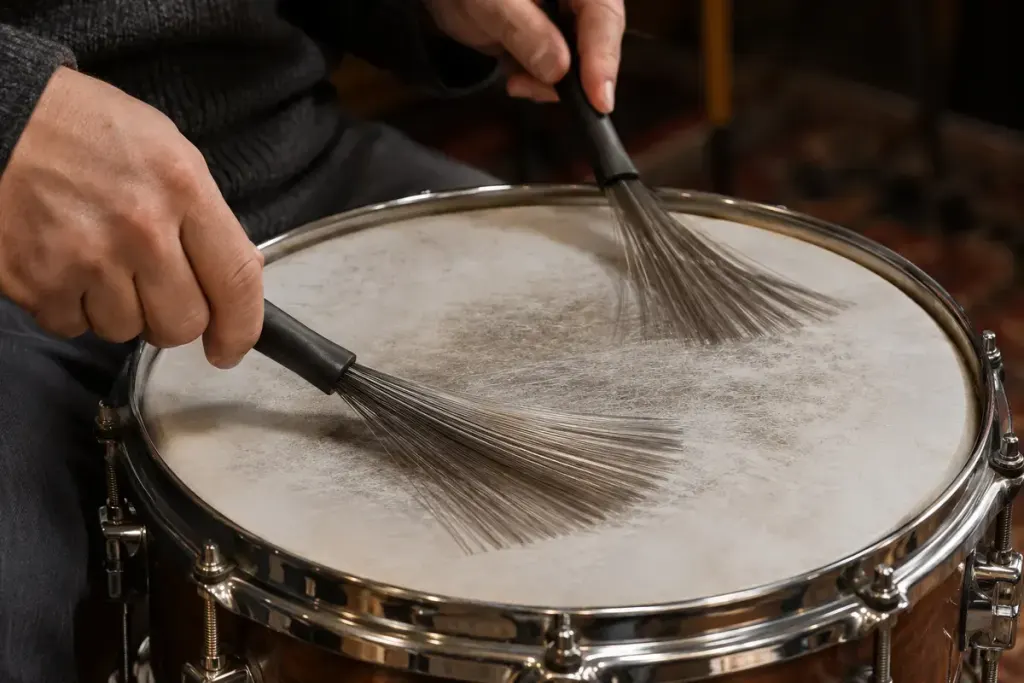
A drummer’s hand moves across the snare, but the brush hardly seems to leave the head. The sound still has rhythm. With brushes, a pulse can emerge through a changing sweep as well as through separate taps.
Wire brushes spread into a fan, and their contact with a suitable drumhead produces a textured sound. Vic Firth’s description of its Steve Gadd brushes discusses how the wire design affects gliding across coated heads. It is a useful reminder that the surface and the brush interact; the result is not simply a quieter drumstick.
Follow one hand at a time
When watching a clear performance video or a live demonstration, first listen for the sustained swishing layer. Then notice accents and taps around it. One hand may maintain a flowing pattern while the other adds more sharply defined events, although arrangements vary with player and musical context.
Try describing the texture without immediately naming a genre: smooth, grainy, pulsing, sparse or interrupted. That vocabulary helps you hear changes within a performance instead of reducing every brush passage to “soft jazz”.
Use a short listening comparison
Choose a brief passage you can replay legally. On one listen, follow the melody. On the next, concentrate on what continues underneath held notes and pauses. Does the brush texture remain steady, grow denser or leave space?
Write one sentence about a specific moment rather than rating the whole drummer. For example, an observation might be that the sustained texture stops just before a new phrase, making the next entrance feel clearer. Check the recording again to see whether that is actually what happened.
If you play, learn basic brush movement with appropriate equipment and an instructor’s guidance rather than pressing harder to imitate a sound. If you only listen, recognising continuous contact already opens another layer of detail: rhythm can be drawn across a surface as well as struck into it.