
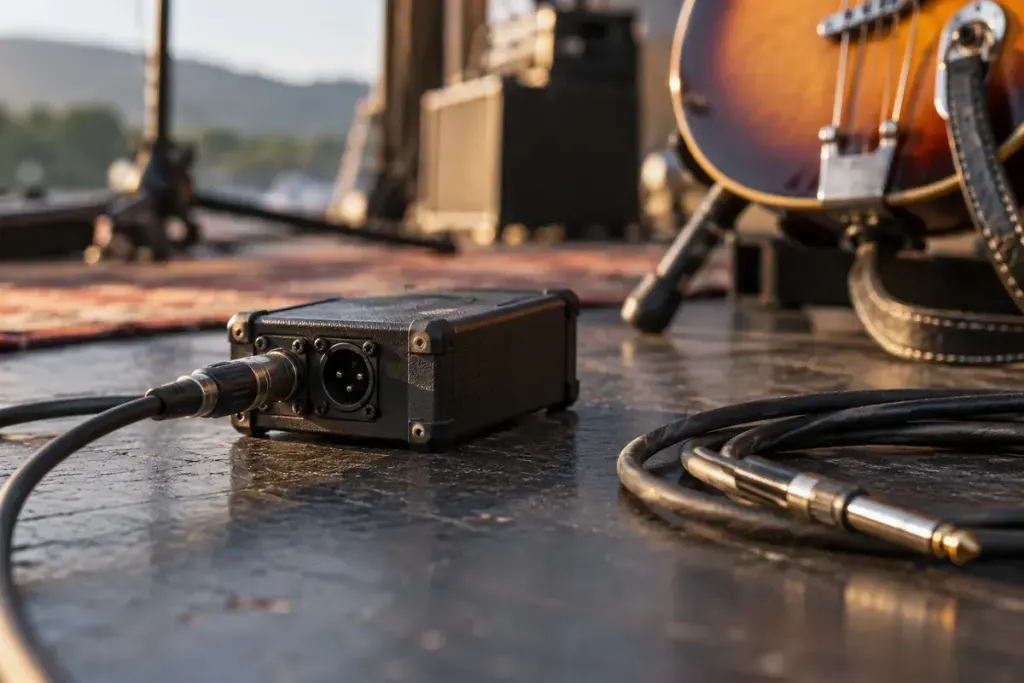
A keyboard and a vocal microphone both reach the mixing desk, but they may not take the same route. The small box beside the instrument can be doing a specific electrical job before the signal joins the stage cable run.
Radial Engineering explains a conventional DI box as converting an unbalanced, high-impedance instrument output into a balanced, low-impedance mic-level signal. This helps connect suitable instruments to the sound system. It does not mean every output on every instrument should be connected to any available box.
Tell the engineer what is coming out
Identify the instrument, the output connector and whether you intend a mono or stereo feed. Two sockets on a keyboard do not automatically mean the venue has planned two channels. Agree the arrangement before the changeover begins.
For an illustrative input-list note, “keyboard, stereo left/right outputs; confirm two DI channels” is more useful than “keyboard cable”. It gives the sound team a question it can resolve with the performer.
A guitar’s pickup output, an amplifier’s speaker output and a headphone output are not interchangeable. Do not connect a speaker output to a DI unless the exact unit is explicitly designed and rated for that use and the engineer has confirmed the setup.
Leave the controls in an agreed state
DI models differ in power needs, input handling and controls. Ask the engineer about pads, phantom power and any ground-lift switch. A ground-lift function on an audio device is not permission to defeat the protective earth on mains equipment.
Keep the box and cables positioned so they do not become a trip hazard or get pulled by movement on stage. Label the channel at a practical point if the crew’s process calls for it, and leave the route accessible during the sound check.
If the signal hums, distorts or disappears, describe the symptom and stop changing several controls at once. Tell the engineer what changed immediately before the problem. That information is more useful than repeatedly swapping cables while the rest of the band waits.
A DI is easiest to understand as one part of a planned signal path. Knowing its job helps a performer provide the right details without having to redesign the venue’s audio system.