
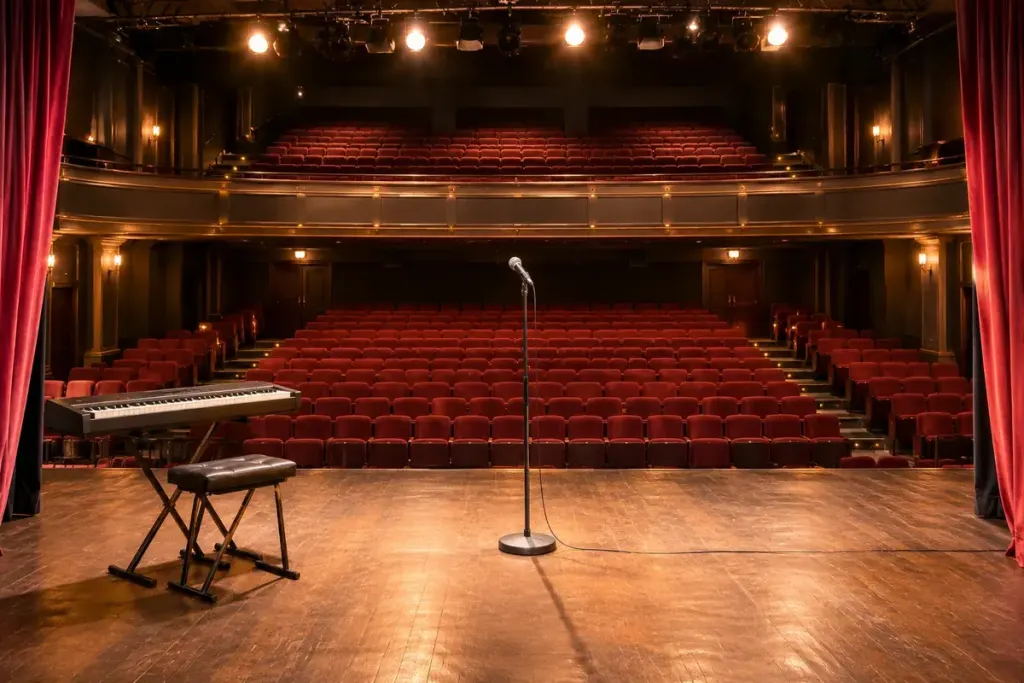
“Put it on the left” sounds clear until one person is standing on stage and another is looking at the stage from the room. They are pointing toward opposite sides. Performance spaces use stage and house directions to keep that viewpoint problem from travelling into a rehearsal.
The Wolf Trap National Park theatre-language guide sets out the relationship: stage left is the performer’s left when facing the audience. House right describes that same physical side from the audience’s viewpoint.
Try it before the room gets busy
Imagine a singer facing the audience. A keyboard placed to the singer’s left is stage left. An audience member looking toward that keyboard sees it on their right: house right. The object has not moved; the reference point has changed.
Now imagine the singer turns to face the drummer. Stage left does not swap sides just because the singer turns around. The convention stays tied to the standard performer-facing-audience viewpoint, which is what makes it useful.
On a simple stage plan, label the audience edge as well as the left and right sides. A plan forwarded as a cropped image can otherwise lose the clue that explains its orientation.
Use the whole direction when it matters
For a small live-music event, a clear instruction might identify the object, side and intended position: a stand on stage left, beside the keyboard position shown on the plan. Avoid relying on “over there” after people move to another part of the room.
Audience wayfinding may use house directions or named doors, depending on the venue. Do not assume a crew instruction is also the best wording for a guest. Confirm the entrance name printed on tickets and signs.
These terms are small pieces of shared vocabulary, but they remove a surprisingly common source of confusion. Establish the viewpoint while everyone has time to check it, and the later instruction can be shorter without becoming ambiguous.