
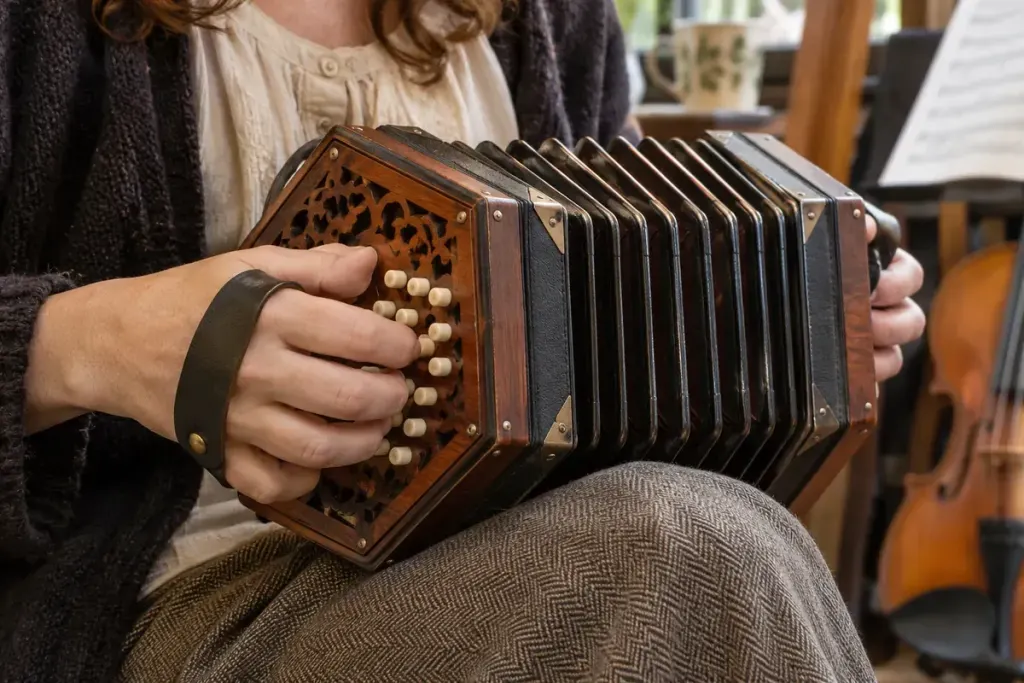
Two musicians can both be pushing bellows and pressing buttons while using quite different note layouts. Calling every small bellows instrument an accordion may be understandable at first glance, but the playing system explains much more about what the hands are doing.
A concertina usually places buttons at both ends of a compact bellows. The International Concertina Association’s guide to concertina systems distinguishes English, Anglo and several Duet arrangements. An Anglo button generally gives different notes on push and pull; English and Duet systems use the same note in either direction. Even within a family, layouts and ranges differ.
Ask about the system, not just the button count
A piano accordion makes its keyboard easy to recognise, but button accordions complicate a quick visual comparison. Some organise melody and bass accompaniment in a way that is quite different from a concertina. The English Folk Dance and Song Society’s instrument guide provides useful introductions to these related instruments.
At a demonstration, ask the player which system they use and whether reversing the bellows changes the note. Then watch one short phrase. You may begin to connect a change of direction with the sound rather than assuming every bellows movement has the same musical function.
A photograph cannot always settle the identification. A case shape, maker’s label and clear view of both ends can help, but a knowledgeable player or museum record is a better guide than a guess from size alone.
Listen without ranking the instruments
Try following the melody first, then the accompaniment and phrasing. Different systems create different possibilities and practical challenges; a compact instrument is not automatically a simplified version of a larger one.
If you are considering lessons, ask to try a suitable instrument with a teacher before buying. The system you learn matters more than choosing the one whose buttons look most familiar in a photograph.