
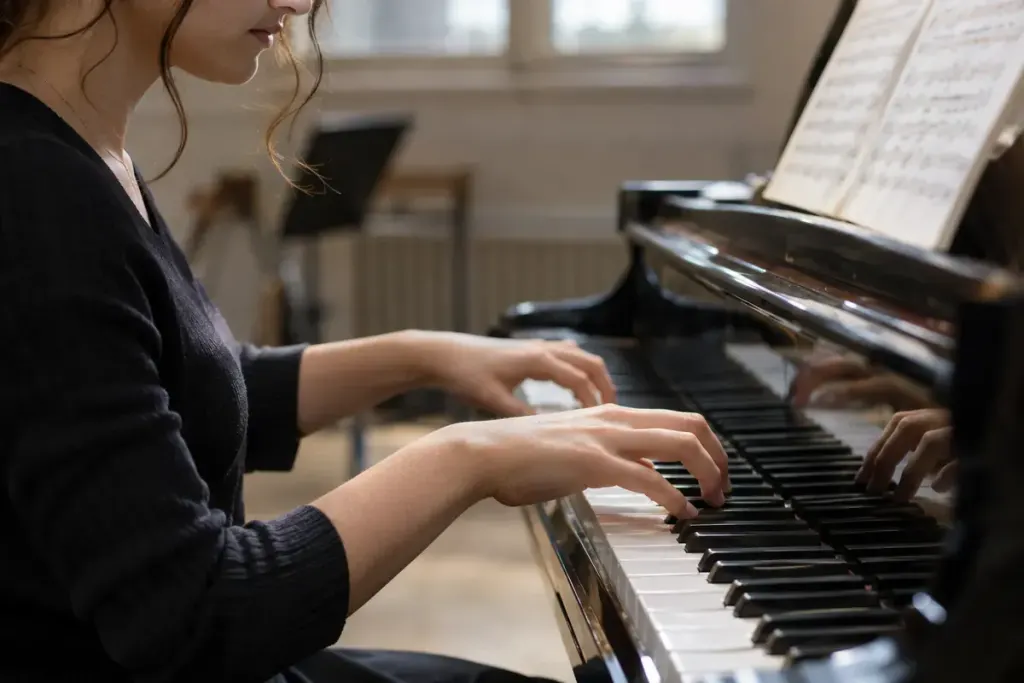
A pianist seems to linger over a note, then lets the phrase move forward. The music has not necessarily lost its pulse. The performer may be shaping time expressively through rubato.
Carnegie Hall’s music-education vocabulary describes rubato as freely adjusting tempo for expression. That concise definition is a starting point for listening, not a rule that every performer must stretch and recover time in exactly the same way.
Choose a short passage from a recording you can replay legally. On the first listen, follow the phrase without counting. Notice where it seems to lean forward, pause or settle. On the second, gently follow the underlying pulse and observe where the performance departs from an even spacing.
Describe the change before judging it
Write something specific: “The arrival note lasts longer than I expected, and the following notes move more freely.” This is more informative than calling the whole performance slow. A passage can contain local flexibility without adopting one new tempo for everything that follows.
Now compare another performance of the same passage. Keep the musical location constant and listen for a different shape. Do not assume that one recording’s duration reveals every interpretive choice; pauses, repeats and other decisions may also affect the total.
If you play an instrument, explore the passage with a teacher or within an appropriate practice method. Learn the written rhythm and phrase first, then consider how expressive timing serves it. Rubato should not become a label that hides difficulty keeping a rhythm you have not yet learned.
The listening reward is a more precise description of musical movement. Instead of deciding only whether a player is fast or slow, you begin to hear how time is distributed within the phrase and how that distribution affects the arrival of the next idea.