
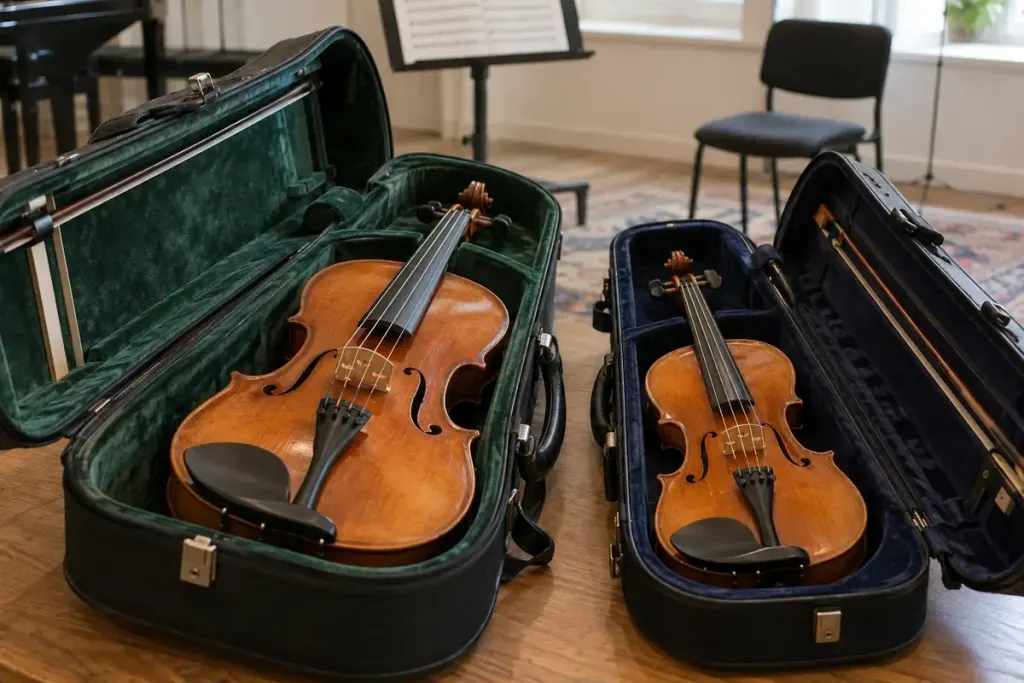
From the audience, a viola can resemble a slightly larger violin. Listen to its lowest open string, however, and the difference becomes much easier to place. The viola is tuned C–G–D–A from low to high, while the violin uses G–D–A–E.
The Philharmonia’s introduction to the viola describes its position as the alto voice of the string family and its lowest note as a perfect fifth below the violin’s. It also demonstrates the instrument through a player rather than reducing its identity to a size comparison.
Follow the middle of the texture
When listening to a string ensemble, it is tempting to follow the highest melody and treat everything beneath it as background. Try the opposite for a short passage. Listen for the line between the bass and the top part: does it sustain a harmony, repeat a rhythm or move against the melody?
The viola may carry that inner movement, but it can also take a prominent melodic role. Its function changes with the score. Do not assume that the instrument is always supporting another player or that a lower range means less demanding music.
A useful listening exercise is to hear a short solo demonstration first, then return to an ensemble passage. The solo sound gives your ear a reference. In a recording where the instruments blend closely, the score or a performance video can help you find the part without pretending every line is easy to isolate by ear.
Compare the same phrase, not only the loudest note
Notice the start of the sound, its sustained colour and how it fades. Register, bowing and the player’s choices all affect what you hear. One recording does not establish a fixed personality for every viola, just as one bright violin sound does not describe the entire instrument family.
For a concert notebook, write the musical job you noticed: “moving inner line under a held melody” says more than “warm sound.” The tuning gives you an entry point, but following the part reveals why the composer placed that voice in the ensemble.