
Malta Looks Tiny on the Map, So Why Does Trying to See Everything Make You Miss the Best Part?
Sundown Malta >> Travel Tips>> Malta Looks Tiny on the Map, So Why Does Trying to See Everything Make You Miss the Best Part?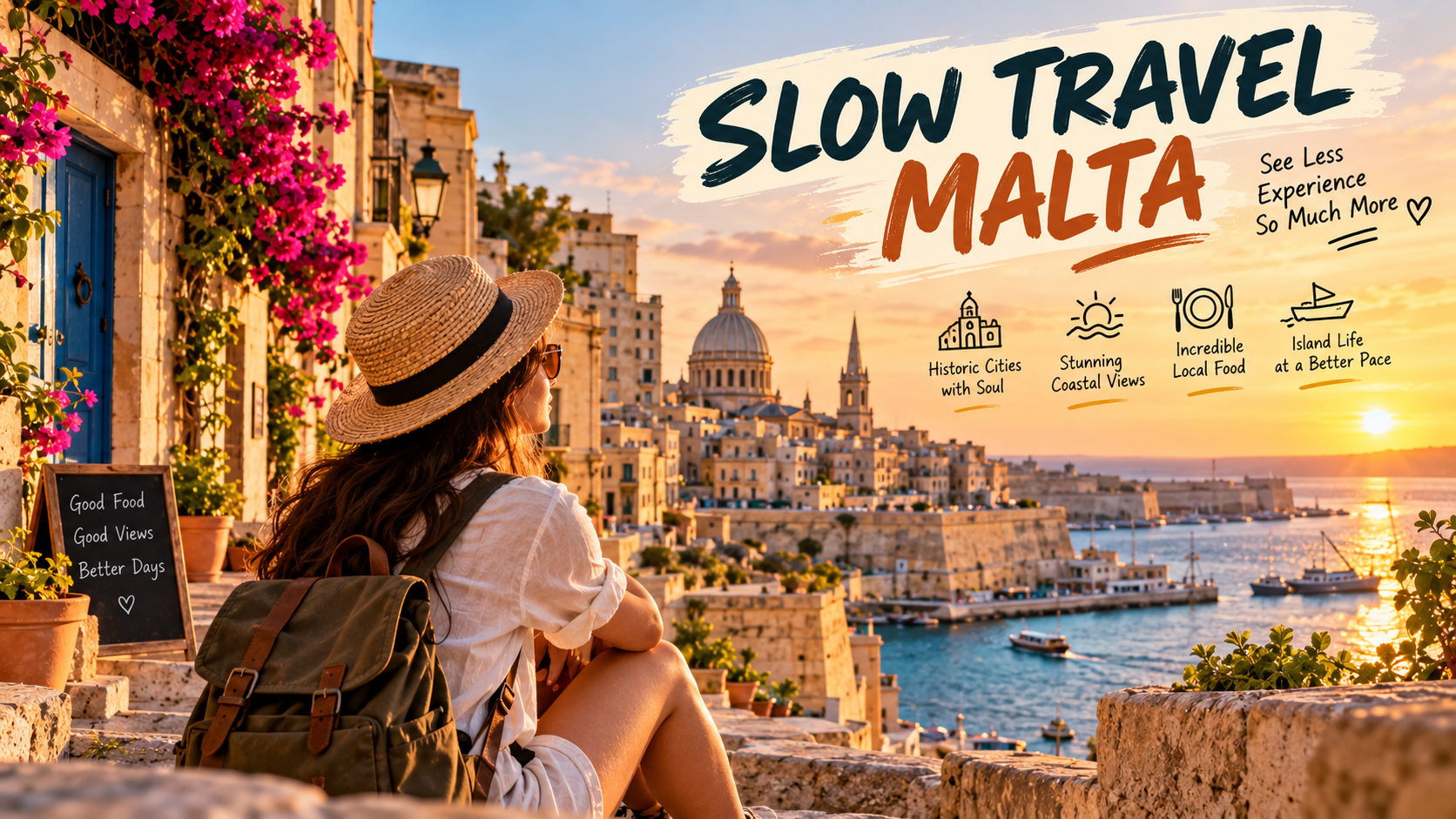
Malta Looks Tiny on the Map, So Why Does Trying to See Everything Make You Miss the Best Part?
Malta looks almost dangerously easy to plan.
Open a map and the islands seem compact.
Valletta here.
Mdina over there.
The Three Cities just across the harbour.
Beaches to the north.
Fishing villages to the south.
Gozo only another island away.
Comino sitting conveniently between them.
It creates a very tempting thought:
Surely you can see everything.
So the itinerary begins growing.
Valletta in the morning.
Mdina after lunch.
A coastal viewpoint before sunset.
Dinner somewhere else.
Gozo tomorrow.
Comino the next day.
Another beach.
Another church.
Another village.
Another boat.
Another photograph.
By the end of the trip, you may have technically visited an impressive portion of Malta.
But there is another possibility.
You moved through the islands so quickly that you never really stayed anywhere long enough to notice them.
You saw Valletta’s streets without seeing how they change when the daytime crowds thin.
You entered Mdina, photographed the limestone lanes, and left before its quietness became the actual experience.
You crossed the harbour, walked through Birgu, checked the map, and immediately started thinking about where you had to go next.
You visited Gozo but spent most of the day moving between stops.
You ate Maltese food because it was on a list rather than because you happened to be hungry near a bakery that smelled too good to ignore.
Nothing was necessarily wrong.
You saw beautiful things.
You probably returned with hundreds of photographs.
But Malta can reward a different kind of trip.
One where distance is not treated as an invitation to pack more into the day.
One where a small island is allowed to feel large.
That is the idea behind slow travel Malta.
Not traveling lazily.
Not deliberately wasting time.
Not refusing to visit famous places.
Simply creating enough space for the destination to become more than a collection of locations.
Malta’s Small Size Can Trick You
Large countries force travelers to make choices.
If two cities are hundreds of kilometers apart, you immediately understand that visiting both requires time.
Malta creates a different psychological effect.
Places appear close.
And geographically, many of them are.
That makes adding “just one more stop” feel harmless.
One more village.
One more beach.
One more church.
One more viewpoint.
The problem is that geographic distance is only one kind of distance.
Fifteen Kilometers Can Still Change the Entire Mood
Travel from a busy waterfront area into an old fortified city and the experience changes.
Move from Valletta’s grand streets toward quieter residential lanes elsewhere and it changes again.
Cross to Gozo and the rhythm can feel different even though you have not traveled very far in global terms.
Malta compresses variety.
That is precisely why rushing through it can be counterproductive.
The places may be close together.
Their personalities are not interchangeable.
Do Not Treat the Islands Like One Giant Attraction
There is no single “Malta experience.”
A morning wandering Valletta does not feel like an evening in Mdina.
A harbour walk in the Three Cities does not feel like a coastal day on Gozo.
A beach afternoon has a different rhythm from exploring old streets.
If you schedule all of them as equal two-hour blocks, you flatten those differences.
Destinations become boxes.
Arrive.
Look.
Photograph.
Leave.
Slow travel allows each place to keep some of its character.
Start by Accepting That You Will Miss Something
This is surprisingly difficult.
Especially on a first visit.
You have limited vacation days.
Flights cost money.
You may not know when you will return.
So leaving anything unseen feels wasteful.
But you will miss something anyway.
Even if you spend a week.
Even if you spend two.
There will always be another village.
Another swimming spot.
Another restaurant.
Another church.
Another street.
Another viewpoint.
Another event.
Accepting this early makes the rest of the trip easier.
The Goal Is Not to Complete Malta
Malta is not a checklist that becomes 100% complete after visiting enough pins.
You do not “finish” Valletta because you walked its main streets.
You do not “finish” Gozo because a tour drove you around the island.
You do not “finish” Maltese food because you tried five dishes.
Travel becomes more interesting when completion stops being the goal.
Instead ask:
What do I actually want to experience?
Give Valletta More Than a Walk-Through
Valletta can initially look like a place that should be easy to cover.
Its historic core is compact.
That makes travelers move quickly.
Walk one street.
Visit one landmark.
Look across the Grand Harbour.
Lunch.
Leave.
But compact cities often reward repetition.
Walk the same street at a different hour.
Turn down a staircase you ignored earlier.
Sit somewhere instead of passing through.
Have coffee.
Look at balconies.
Notice doors.
Listen.
A city becomes more legible when you stop constantly trying to progress through it.
The Main Street Is Only the Beginning
Busy streets naturally collect visitors.
Shops.
Restaurants.
Major buildings.
Tour groups.
They are useful orientation points.
But step away from them.
Walk downhill.
Take a side street.
Follow a staircase.
See where residential life begins to mix with historic architecture.
The difference between visiting a city and spending time in it often begins one street away from the obvious route.
Look Up
Travelers spend enormous amounts of time looking at maps and phones.
Malta rewards looking upward.
Enclosed balconies.
Stone facades.
Church domes.
Signs.
Shutters.
Architectural details.
Laundry.
Weathered surfaces.
The vertical layers of a street often tell more of its story than the destination pin at the end.
Then Look Down the Street
Malta’s topography creates dramatic street perspectives.
A narrow urban corridor suddenly opens toward blue water.
Stone steps descend.
Sunlight changes as buildings cast shade.
A street that seemed ordinary on the map becomes memorable simply because of how it meets the sea.
You do not need another attraction.
Sometimes the street itself is enough.
Do Not Schedule Every Valletta Hour
A city like Valletta benefits from having one or two anchors.
Perhaps there is a historical site you genuinely want to visit.
A church.
A museum.
A particular restaurant.
Fine.
Book what requires booking.
Then leave space around it.
If every hour has a destination, wandering becomes impossible.
And wandering is part of the point.
The Harbour Is Not Just Something to Photograph
The Grand Harbour helps explain Malta visually.
Fortifications.
Water.
Cities facing each other.
Boats moving between them.
Instead of only finding the famous viewpoint, experience the relationship between both sides.
Look from Valletta.
Then cross.
The perspective changes.
Suddenly the city you were standing inside becomes part of the landscape.
Crossing the Harbour Changes the Story
The Three Cities sit across the Grand Harbour from Valletta, but their atmosphere can feel noticeably different. Birgu, Senglea, and Cospicua combine fortifications, marinas, residential streets, and older layers of harbour life, making the crossing more than a way to collect another sightseeing stop. Stonepath
Do not arrive only to photograph the waterfront and leave.
Walk inland.
Find quieter lanes.
Notice where tourism ends and ordinary life continues.
Birgu Deserves Wandering
A map may direct you toward the major historical points.
Use it.
Then put it away for a while.
Old urban environments often make more sense through wandering than through navigation.
Turn left because the lane looks interesting.
Follow shade.
Walk toward the water.
Then climb again.
You may briefly lose your orientation.
That is not always a problem.
Getting Slightly Lost Is Different From Being Unsafe
Slow travel does not mean abandoning awareness.
Know your surroundings.
Keep access to navigation.
Understand how you will return.
Respect private areas.
But within safe public spaces, you do not always need to follow the fastest route.
A wrong turn can simply become another street.
Sit Near the Water Without Doing Anything
This sounds almost offensively unproductive in a travel guide.
Do it anyway.
Order something.
Sit.
Watch boats.
Watch people.
Let twenty minutes pass without using them to accomplish anything.
Travel memories often form during these pauses.
Not only during headline attractions.
Mdina Should Not Be Treated Like a Movie Set
Mdina photographs beautifully.
Honey-colored stone.
Narrow streets.
Old doors.
Small squares.
Soft evening light.
It is easy to arrive thinking mainly about photographs.
But the atmosphere is the attraction.
Its quieter streets and contrast with busier parts of Malta are a major part of why visitors find it distinctive, particularly when approached as a place to wander rather than a checklist of sights. Love Valletta
If you rush, you may capture the appearance and miss the feeling.
Walk Slower Than Necessary
There is no prize for crossing Mdina quickly.
Take the lane that appears to go nowhere.
Stop near a doorway.
Look at stone details.
Let faster groups pass.
Wait until a street empties.
Then continue.
Some places reveal themselves through movement.
Others reveal themselves when movement slows.
Stay Long Enough for the Light to Change
Morning and evening can transform stone architecture.
Color becomes warmer.
Shadows lengthen.
Textures become stronger.
The same wall can look completely different.
If photography matters to you, spending longer in fewer places often produces better photographs than racing between many locations.
You have time to wait.
Rabat Is Not Merely the Place Outside Mdina
It is easy to make Mdina the headline and treat neighboring Rabat as an extension.
But once you leave the fortified setting, the mood changes.
That transition itself is interesting.
Spend time in ordinary streets.
Stop for food.
Let the destination move from monumental history toward everyday life.
Contrasts help places feel real.
Famous Places Become More Interesting When Paired With Ordinary Ones
A cathedral.
Then a neighborhood bakery.
A museum.
Then a residential street.
A famous viewpoint.
Then a local square.
Travel does not need to choose between important landmarks and ordinary life.
The combination provides context.
The extraordinary becomes easier to understand when surrounded by the everyday.
Do Not Hunt Only for “Authentic” Malta
The word authentic causes strange travel behavior.
People begin avoiding anywhere with tourists.
A place becomes suspicious because other visitors like it.
A popular restaurant is automatically dismissed.
A famous attraction becomes “too touristy.”
But local life and tourism can coexist.
Valletta is still Malta when visitors are present.
Mdina does not stop being historically interesting because people photograph it.
A beach does not become worthless because it is famous.
Tourism Is Part of the Present-Day Destination
You are a visitor too.
There is little value in pretending otherwise.
The goal is not to discover a Malta untouched by every other traveler.
The goal is to engage respectfully with the Malta that exists.
That includes popular places.
Quiet places.
Tourism.
Residential life.
History.
Modern businesses.
Beaches.
Nightlife.
Religious traditions.
Daily routines.
Destinations are not preserved museum displays.
Gozo Is Where Many Travelers Finally Slow Down
A day trip to Gozo is possible.
Many people do it.
They arrive.
Move between major locations.
Return.
That can work if time is limited.
But staying longer changes the experience.
Gozo is often recommended as a separate base for travelers who want a slower rhythm, rather than treating the island purely as another collection of stops. Discover Valletta
An overnight creates something a day tour cannot easily provide:
Evening.
Evening Changes Places
Day visitors leave.
Traffic patterns change.
Restaurants shift into dinner rhythm.
Light softens.
Streets become quieter.
The destination stops performing at peak visitor intensity.
This is one of the strongest arguments for sleeping somewhere rather than repeatedly visiting on day trips.
You experience the hours between attractions.
Morning Does the Same Thing
Wake somewhere.
Walk outside before the day becomes busy.
Find breakfast.
Watch shops open.
See streets before tour schedules fully begin.
Morning creates familiarity.
Even after one night.
Suddenly you are not arriving.
You are already there.
Staying Overnight Changes Your Relationship With Distance
On a day trip, the return journey is always waiting.
At 15.00, you start calculating.
How long back to the ferry?
When should we leave?
What if transport is delayed?
Stay overnight and that pressure disappears.
You can watch sunset.
Eat slowly.
Walk afterward.
Return to your accommodation when you are ready.
That is a different kind of freedom.
Do Not Turn Gozo Into a Race Around the Island
The temptation returns immediately.
Citadel.
Beach.
Coast.
Village.
Another viewpoint.
Another church.
Another bay.
Because Gozo is relatively compact, everything looks combinable.
Technically, many things are.
Experientially, there is still a limit.
Pick a few.
Let geography organize the day.
Choose a Side of the Island
Instead of zigzagging constantly, spend part of the day within one area.
Walk.
Stop.
Eat nearby.
Then move.
This reduces transportation and increases actual time spent experiencing places.
Travel efficiency should create slowness.
Not simply make room for more stops.
A Beach Does Not Need to Be Followed by Another Beach
You find somewhere beautiful.
The water is good.
The weather is right.
You are comfortable.
Then someone says:
“We need to go. The next beach is on the list.”
Why?
If you already found what you wanted, stay.
The next location may be better.
It may also be almost the same experience with another hour of logistics.
Comino Requires a Different Mindset
Many travelers associate Comino primarily with the Blue Lagoon and its striking water.
That makes it an obvious candidate for a boat day.
But conditions, crowd levels, sea conditions, and access arrangements can affect the experience, so it makes sense to treat a water-based day with more flexibility than a rigid city itinerary. Discover Europe
Do not build an entire trip around one perfect photograph.
Water destinations depend on conditions.
Blue Water Looks Better When You Are Actually Swimming in It
This sounds obvious.
Yet it is easy to spend half the visit documenting the color.
Phone.
Camera.
Video.
Portrait.
Another angle.
Drone where permitted.
Then suddenly it is time to leave.
Take photographs.
Of course.
Then put the device away.
Go into the water if conditions and your abilities make that appropriate.
Feel the temperature.
Float.
Look back toward the shore.
The memory needs something beyond pixels.
Malta Is Not Only a Summer Swimming Destination
The islands contain far more than beaches.
Architecture.
History.
Food.
Harbour landscapes.
Village life.
Religious traditions.
Walking.
Coastal scenery.
Seasonal events.
Traveling outside peak beach conditions changes the emphasis rather than eliminating the destination.
A place should not be reduced to the weather shown in tourism advertising.
Summer Changes the Pace
Heat matters.
A midday walking itinerary that looks reasonable on paper can feel completely different under strong sun.
Instead of fighting the conditions, build around them.
Earlier walks.
Longer lunches.
Indoor visits.
Shade.
Swimming.
Rest.
Later evenings.
Slow travel works partly because it allows the environment to influence the schedule.
The Mediterranean Has Its Own Clock
You may arrive with a schedule built around how you live at home.
Wake.
Breakfast.
Sightseeing.
Lunch.
More sightseeing.
Dinner.
Sleep.
But destinations have local rhythms.
Restaurants become busy at different times.
Evenings extend.
Public spaces change after sunset.
Heat influences daytime behavior.
Observe before forcing your usual routine onto the place.
Eat When Food Becomes Part of the Experience
Travel food lists can become absurd.
Breakfast spot.
Pastizzi.
Lunch restaurant.
Dessert.
Coffee shop.
Dinner.
Gelato.
Every item becomes mandatory.
By the third day you are eating because the itinerary says so.
Food should be explored with appetite.
Not obligation.
Start With the Bakery
A bakery can tell you a surprising amount.
What people buy quickly.
What is eaten in the morning.
Which pastries disappear first.
How much things cost.
Who comes in.
What smells dominate the room.
You do not need a formal food tour to begin understanding a food culture.
Sometimes you need to stand in line.
Try Pastizzi Without Turning It Into a Ceremony
Some foods become so heavily recommended that travelers approach them like sacred artifacts.
Relax.
Buy one.
Eat it.
If you like it, have another during the trip.
Try a different filling.
Try it somewhere else.
Local food becomes more meaningful when it becomes part of normal travel rather than a one-time tasting achievement.
Do Not Eat Rabbit Just Because a List Told You To
Traditional foods matter.
But curiosity should guide the meal.
Read the menu.
Ask questions.
Understand what you are ordering.
If something genuinely interests you, try it.
If not, choose something else.
Respecting a cuisine does not require consuming every dish associated with it.
Return to a Restaurant You Loved
This feels wrong to many travelers.
There are hundreds of places.
Why repeat one?
Because the meal was good.
Because the staff were welcoming.
Because you liked the street.
Because yesterday’s pasta made you happy.
Novelty is not automatically more valuable than familiarity.
Returning can turn a restaurant from a recommendation into part of your trip.
Order Something Different the Second Time
Now repetition becomes exploration.
Same place.
Different dish.
You already understand the environment.
You can focus more on the food.
Maybe someone recognizes you.
A tiny connection appears.
This is how a destination begins feeling less anonymous.
Leave Room for Long Lunches
Not every meal needs to be squeezed between attractions.
A long lunch can be the afternoon.
Good food.
Conversation.
Wine if appropriate for you.
Coffee.
Dessert.
Watching the street.
Then perhaps one evening walk.
A travel day does not need six activities to feel complete.
Dinner Can Be the Destination
Instead of:
“What are we doing tonight?”
Try:
“We are going to dinner.”
Walk there slowly.
Eat.
Stay.
Walk back.
That is enough.
Travel becomes exhausting when entertainment must continue every minute until sleep.
Sunset Does Not Need an Audience of Attractions
The name Sundown Malta almost demands this point.
Sunset can become another item to optimize.
Best sunset location.
Best viewpoint.
Best photograph.
Best rooftop.
Best cliff.
Sometimes yes.
Choose somewhere beautiful.
But other evenings, watch from wherever you happen to be.
A harbour.
A terrace.
A street.
A beach.
A ferry.
Sunset happens across the island.
You do not always need to chase it.
The Best Sunset Might Be the One You Did Not Plan
You are walking back.
The light changes.
Buildings turn warm.
The sky begins shifting.
You stop.
There is no famous viewpoint.
No crowd.
No reservation.
Just ten minutes where everyone becomes quiet.
Those moments are difficult to schedule precisely.
You create them by leaving enough room for them to happen.
Golden Hour Rewards Slow Travelers
If you spend only forty-five minutes somewhere, you receive whatever light exists during those forty-five minutes.
Stay longer and the place changes around you.
Harsh afternoon light softens.
Stone warms.
Shadows stretch.
Water changes color.
Lights begin appearing.
Time becomes part of the scenery.
Night Is Not Merely the Gap Between Sightseeing Days
Historic streets after dark feel different.
Harbours feel different.
Squares feel different.
Restaurants spill into the evening.
Churches and fortifications become illuminated.
If every night is spent recovering from an overloaded daytime itinerary, you lose an entire dimension of the destination.
Protect some energy for evening.
You Do Not Need Nightlife to Enjoy Malta at Night
A quiet evening is still an evening.
Walk.
Dinner.
Harbour.
Gelato.
Conversation.
Architecture.
A drink.
Sit somewhere.
Night travel does not automatically mean clubs.
Choose the atmosphere that suits you.
And If You Want Nightlife, Choose It Deliberately
Malta also has areas associated with nightlife.
If that is part of your trip, enjoy it.
But understand the tradeoff.
Late night means slower morning.
Do not plan a 06.00 start after a night that realistically ends at 02.00.
Your itinerary should acknowledge the person actually taking the trip.
Not an imaginary traveler who never becomes tired.
Accommodation Changes the Entire Experience
Where you sleep affects more than convenience.
It determines what you see first in the morning.
Where you walk after dinner.
Whether you need transport every night.
How much neighborhood life you encounter.
Whether the surroundings feel active or quiet.
For travelers interested in slow travel Malta, accommodation should be chosen partly for what it allows you to experience outside sightseeing hours.
Do Not Choose a Base Only by Hotel Price
A cheaper room can be excellent.
But calculate what the location means.
How will you reach the places you care about?
Can you walk anywhere interesting?
Will you repeatedly need taxis?
How long will evening returns take?
Is the surrounding area compatible with the atmosphere you want?
Accommodation is part of travel design.
Valletta Works Differently From a Resort Base
Staying inside or near a historic urban environment gives you immediate access to streets, architecture, food, and evening walks.
A resort-oriented area may offer different conveniences.
Neither is automatically better.
The question is:
What kind of trip are you trying to create?
Choose the base that supports that answer.
Consider Splitting the Stay Only When the Change Adds Something
Moving hotels consumes time.
Pack.
Check out.
Transport.
Wait.
Check in.
Unpack.
So do not change accommodation simply because another town exists.
Move when the second base changes the experience enough to justify the effort.
A Malta base followed by time on Gozo can make sense for a slower trip because the move changes your relationship with the second island.
Changing hotel every night usually does not.
Two Bases Can Feel Like Two Trips
Spend the first part surrounded by harbour cities and urban history.
Then move somewhere quieter.
Suddenly the trip resets.
New morning.
New café.
New streets.
New rhythm.
This can make a week feel richer without adding more attractions.
The difference comes from depth, not quantity.
Public Transport Can Become Part of the Experience
Travelers sometimes treat every minute on transport as wasted.
But buses and ferries reveal geography.
You understand which towns connect.
You see residential areas.
You cross harbours.
You watch the landscape change.
Transport can be slow.
It can occasionally be inconvenient.
But not every journey needs to be optimized into invisibility.
Ferries Give You a Different Malta
A road shows one relationship between places.
Water shows another.
From a ferry, fortifications make sense differently.
Cities become silhouettes.
Harbours reveal their scale.
The crossing itself becomes part of sightseeing.
That is travel efficiency worth appreciating:
Transportation and experience happening at the same time.
Do Not Build Tight Connections Around Transport
Slow travel still needs practical planning.
If you have an airport deadline, ferry connection, reservation, or booked activity, create buffer.
The relaxed approach works because the important logistics are protected.
Missing a flight is not slow travel.
It is simply a problem.
Be flexible where flexibility is safe.
Be conservative where consequences are high.
Walking Reveals Scale Better Than Driving
In a car, distances collapse.
One neighborhood becomes another quickly.
Walking exposes transitions.
Tourist street.
Residential street.
Church.
Small square.
Shop.
Harbour.
Hill.
Stairs.
You begin understanding how the place fits together.
That mental map is one of the quiet pleasures of travel.
But Malta Has Hills
A route that looks short on the map may involve slopes and stairs.
Heat can magnify the effort.
Comfortable footwear matters.
Water matters.
Pacing matters.
Do not measure walking only in kilometers.
Terrain changes the experience.
Stop Before You Are Exhausted
This is an underrated travel skill.
Most people stop after exhaustion.
Feet hurt.
Mood drops.
Everyone becomes hungry.
Then the group begins arguing over where to eat.
Instead, recognize the earlier signs.
You have seen enough for now.
Sit.
Drink something.
Return to the accommodation.
Continue later.
You do not need to extract maximum value from every hour.
A Midday Break Can Improve the Entire Evening
Go back to the room.
Shower.
Change clothes.
Lie down.
Charge devices.
Do absolutely nothing for forty minutes.
Then leave again.
You may feel as if you sacrificed sightseeing time.
But if the break gives you four enjoyable evening hours instead of four exhausted ones, the trade was good.
Traveling Slowly Does Not Mean Never Being Busy
You can still have a full day.
Take a tour.
Hike.
Spend hours exploring.
Visit multiple historical sites.
The difference is intentionality.
A busy day is fine.
Seven consecutive overloaded days are something else.
Slow travel includes intensity.
It also includes recovery.
Alternate Heavy and Light Days
One day:
Major sightseeing.
Next day:
Beach and dinner.
One day:
Gozo exploration.
Next day:
Slow morning and neighborhood walking.
This creates rhythm.
Your trip gains contrast.
And the bigger experiences remain memorable because they are not immediately buried beneath another equally demanding day.
Give Museums Enough Time
Museum fatigue is real.
Trying to visit three serious museums in one afternoon often means absorbing very little from the third.
Choose the ones that genuinely interest you.
Read.
Look.
Pause.
If history is not your main interest, you do not need to visit every historical interior just because Malta has a lot of history.
Travel should reflect curiosity.
Not obligation.
Churches Are Not Merely Architectural Attractions
Malta’s religious buildings are visually striking and culturally significant.
But remember that many remain active places of worship.
Dress and behave appropriately.
Respect services.
Keep noise controlled.
Follow photography rules.
Tourism does not suspend the original purpose of a space.
Festa Culture Is Lived Culture
Village celebrations can add an entirely different layer to a Malta trip.
Decorations.
Music.
Community gatherings.
Religious elements.
Food.
Fireworks in some contexts.
If you encounter a local celebration, approach it as a guest.
Observe.
Learn.
Enjoy.
But remember that the event exists for the community, not as a performance created for visitors.
Do Not Treat Every Tradition as Content
A procession happens.
Phones rise.
People step into pathways.
Everyone tries to capture the perfect clip.
Sometimes the respectful choice is to move back.
Watch.
Understand what is happening.
Not every cultural moment needs to become footage.
Ask Before Photographing People Closely
Public events naturally attract photography.
But individuals are still individuals.
Especially children.
Religious participants.
Workers.
Older residents.
People sitting outside their homes.
A wide street photograph is different from placing a camera close to someone’s face.
Respect is more important than the image.
Learn a Little Context Before You Arrive
You do not need to become a historian.
But understanding basic layers of Malta’s past makes the built environment more meaningful.
Fortifications stop being simply beautiful walls.
Harbours stop being simply scenic.
Architecture begins connecting to events and influences.
A little knowledge dramatically improves observation.
Then Stop Reading and Look Around
There is another extreme.
You spend the entire trip reading plaques.
Listening to audio guides.
Searching every building.
Watching historical videos while standing in the historical place.
Information can become a barrier too.
Learn enough.
Then experience.
You can read more after the trip.
Travel Is Not a Research Assignment
You are allowed to enjoy a building without memorizing its construction date.
You can like a dish without understanding its complete history.
You can sit near the sea without knowing the geological explanation for every rock.
Curiosity is wonderful.
Completion is unnecessary.
Leave the Famous Viewpoint
Take the photograph.
Enjoy the view.
Then walk somewhere else.
Often the interesting part begins nearby.
The path leading away.
A small residential street.
A café without a view.
A bench.
The famous point gets you there.
It does not have to contain the entire experience.
Avoid Comparing Every Place With Somewhere Else
“This looks like Italy.”
“This feels like Greece.”
“This reminds me of Spain.”
Comparisons help us understand unfamiliar places.
But overusing them prevents the destination from becoming itself.
Malta contains Mediterranean influences and connections.
It also has its own combination of history, language, architecture, food, and everyday culture.
Let it remain Malta.
Listen to the Language Around You
Language is part of place.
Even if you do not understand the conversation, listen to its rhythm.
Notice how people switch languages.
Look at signs.
Learn basic greetings if useful.
A destination is not only visual.
Sound builds memory too.
Notice the Doors
This sounds ridiculously specific.
Do it.
Doors.
Balconies.
Knockers.
Stonework.
Tiles.
Small architectural details become recurring visual motifs.
Once you begin noticing them, walking gains another layer.
Suddenly an ordinary residential street becomes interesting.
Notice What People Do in the Evening
Where do families walk?
Where do older residents sit?
Where do people meet?
Which squares become active?
Which streets become quiet?
Observing daily patterns is one of the simplest ways to move beyond sightseeing.
You do not need access to private life.
Public life already tells you plenty.
Visit a Market Without Turning It Into a Shopping Mission
Markets provide color, food, voices, and movement.
Walk.
Look.
Buy something if you actually want it.
You do not need souvenirs from every stop.
Sometimes observing how a market functions is enough.
Buy Fewer Souvenirs, Choose Better Ones
Travel creates a strange purchasing instinct.
Magnets.
Keychains.
Printed shirts.
Objects that seemed essential for five minutes.
Before buying, ask:
Would I want this at home if it did not have the destination name on it?
If yes, perhaps it is worth carrying back.
A useful or meaningful object can preserve memory better than a bag full of generic souvenirs.
Food Can Be a Better Souvenir
Where customs rules allow, locally produced packaged foods can be enjoyable reminders.
But even when you cannot bring something home, taste memory lasts.
A pastry.
A particular coffee.
A meal by the water.
A flavor becomes associated with a place.
Travel souvenirs do not always need to occupy shelf space.
Take Fewer Photographs of the Same Thing
You probably do not need thirty-seven nearly identical photographs of one church facade.
Take a few.
Check one.
Then move on.
Photography should sharpen observation.
Not replace it.
Photograph Details, Not Only Landmarks
A table after lunch.
Morning light in the room.
A ferry ticket.
Stone steps.
A cat sleeping near a doorway.
Your friend’s shoes after a long walking day.
These photographs may look insignificant during the trip.
Years later, they can carry more memory than another perfect postcard view.
Take One Photograph, Then Stay
This can become a simple habit.
Arrive somewhere beautiful.
Take the photograph you wanted.
Then remain for another five minutes without photographing.
Look.
Listen.
Notice temperature.
Wind.
Smell.
People.
That second part is for you.
Not the camera.
You Do Not Need to Post While You Are There
Share later.
Your friends can wait.
The island will not become less real because Instagram sees it tomorrow.
Posting in real time can pull attention away from the experience and toward how the experience appears.
Travel is allowed to be private for a few hours.
Slow Travel Is Also About Spending Differently
When you stay longer in one area, your spending patterns change.
You may return to local businesses.
Buy breakfast nearby.
Use neighborhood shops.
Choose smaller experiences.
Spend less on constant transportation.
Not every euro has to purchase an attraction.
Some of it can support simply being somewhere comfortably.
Do Not Confuse Expensive With Meaningful
A private boat can be wonderful.
A luxury hotel can be wonderful.
A tasting menu can be wonderful.
So can a ferry ride.
A pastry.
A public garden.
A long walk.
A cheap coffee near the harbour.
Price and emotional value are different variables.
A balanced trip can contain both.
Build the Budget Around Priorities
If accommodation atmosphere matters greatly, spend there.
If food matters, reserve budget for restaurants.
If diving is the purpose, prioritize that.
If you mostly want streets, history, and walking, you may not need an expensive activity every day.
Slow travel becomes easier when money follows interests instead of travel status.
Stop Trying to Have the “Best” Version of Everything
Best restaurant.
Best beach.
Best sunset.
Best pastizzi.
Best hotel.
Best viewpoint.
The search for best creates constant dissatisfaction.
What if the next place is better?
Should we leave?
Should we have booked somewhere else?
Good is often enough.
Sometimes excellent appears unexpectedly.
Your Favorite Place May Not Be Famous
It may be a staircase.
A bakery.
A small harbour.
A street near your accommodation.
A bench.
A restaurant you chose randomly.
You cannot predict all emotional responses from reviews.
That is why leaving room matters.
A destination needs opportunities to become personal.
Repetition Creates Attachment
Walk the same route to breakfast three mornings.
On day one, it is unfamiliar.
Day two, you recognize the turn.
Day three, you know where the shade is.
You recognize the shop.
The street becomes yours in a tiny temporary way.
That feeling is almost impossible when changing location every few hours.
Stay Long Enough to Have a Routine
Not a strict routine.
A travel routine.
Morning coffee there.
Walk this way.
Return through that square.
Buy water from the same shop.
Say hello to the same person.
Routine does not make travel boring.
It gives novelty a frame.
Leave One Day Partially Empty
Do not decide what happens.
Wake up.
Look outside.
Ask how everyone feels.
Maybe return somewhere.
Maybe go to the coast.
Maybe visit something missed earlier.
Maybe do almost nothing.
A blank half-day can become the moment where the trip finally feels like yours instead of something copied from research.
Bad Weather Can Create Good Travel Days
Rain arrives.
Boat plan canceled.
Beach gone.
Now what?
Museum.
Long lunch.
Coffee.
Shopping.
Reading.
Exploring sheltered streets.
Rest.
Some of the strongest travel memories begin with:
“That wasn’t the plan.”
Flexibility converts disruption into possibility.
Wind Matters on Islands
Water activities and coastal experiences depend on conditions.
A beautiful forecast icon does not automatically mean ideal sea conditions everywhere.
Listen to local operators.
Respect closures and warnings.
Move water-based activities when necessary.
A slow itinerary makes this easier because not every day is locked.
Do Not Fight the Destination
This may be the core principle.
Hot?
Slow down.
Windy?
Change the coast plan.
Tired?
Rest.
Crowded?
Come back later.
Loving somewhere?
Stay longer.
Not enjoying somewhere?
Leave.
The itinerary should respond to reality.
Reality should not be forced to obey the itinerary.
A Three-Day Trip and a Ten-Day Trip Should Not Look the Same
Short trips require stronger choices.
You cannot recreate a ten-day itinerary at triple speed and expect the same experience.
If you have three days, choose a few dimensions of Malta.
Perhaps Valletta and the harbour.
Mdina and Rabat.
Then one larger day depending on your interests.
The goal is not coverage.
It is coherence.
With More Time, Add Depth Before Adding Distance
Suppose you gain two extra days.
The immediate instinct is:
More destinations.
But consider:
Stay overnight on Gozo.
Return to somewhere you liked.
Add a beach day.
Spend more time in the Three Cities.
Explore a neighborhood without an attraction attached.
Extra time can deepen a trip instead of expanding it.
One Week Does Not Need Seven Major Excursions
You can have:
Two substantial sightseeing days.
One Gozo day or overnight.
A beach or water day.
A slower neighborhood day.
A flexible day.
A final day returning somewhere you loved.
That still creates a rich trip.
Variety comes from different rhythms as much as different locations.
Your Last Day Should Not Feel Like a Final Exam
Travelers sometimes use the last day to panic.
What have we missed?
Quick.
One more museum.
One more neighborhood.
One more meal.
One more souvenir.
Then everyone arrives at the airport exhausted.
Instead, let the final day close the trip.
Breakfast somewhere familiar.
One final walk.
Return to a favorite place.
Buy something you already decided you wanted.
Leave with enough time.
A journey benefits from an ending.
Return Somewhere Before You Leave
This is one of the nicest slow-travel habits.
Go back.
The waterfront you liked.
The café.
The square.
The bakery.
The viewpoint.
The second visit feels different because the place is no longer completely new.
You notice more.
And you create a sense of farewell.
Do Not Save Everything for “Next Time” Either
Slow travel is not an excuse to avoid planning.
If there is one thing you would deeply regret missing, prioritize it.
Book the ticket.
Wake up early.
Travel across the island.
Do it.
The point is not to reject major attractions.
It is to distinguish genuine priorities from compulsive accumulation.
Know Your Three Non-Negotiables
Before arriving, choose three experiences.
Not thirty.
Maybe:
Explore Valletta slowly.
Spend an evening around Mdina and Rabat.
Stay on Gozo.
Your choices will differ.
Once those priorities are protected, everything else becomes flexible.
That dramatically reduces FOMO.
Let Malta Become Familiar
The first day, everything is new.
Yellow limestone.
Street signs.
Buses.
Harbour views.
Food names.
Balconies.
Churches.
By the fourth day, patterns emerge.
You begin recognizing things.
This transition from novelty to familiarity is one of travel’s best stages.
Do not move so fast that you never reach it.
The Best Travel Story Might Sound Boring on Paper
“What did you do that afternoon?”
“We sat by the harbour for three hours.”
That sounds unimpressive in an itinerary.
But perhaps you ate.
Talked.
Watched boats.
Saw the light change.
Walked afterward.
And still remember it years later.
Travel value cannot always be measured by activity count.
A Small Island Can Hold a Long Day
You do not need enormous geographic scale for a destination to feel expansive.
Time creates scale.
Walk slowly.
Stop often.
Stay overnight.
Return.
Notice changes.
A five-kilometer area can contain days of experience when you stop treating movement as the main objective.
This Is What Slow Travel Malta Really Means
It does not require staying for a month.
It does not require avoiding popular places.
It does not require renting a farmhouse and pretending to be local.
It simply means giving the islands enough time to reveal differences.
Valletta as more than a capital.
Mdina as more than a photograph.
Rabat as more than an extension.
The Three Cities as more than a harbour crossing.
Gozo as more than a day trip.
Food as more than a checklist.
Sunset as more than a scheduled viewpoint.
Travel as more than movement.
Conclusion
Malta’s compact geography makes it incredibly tempting to build a trip around quantity.
One more city.
One more beach.
One more historical site.
One more island.
One more restaurant.
And because many places appear close together, the itinerary can look perfectly reasonable on a map.
But slow travel Malta begins when you recognize that short distances do not mean every experience should be compressed.
Give Valletta time beyond its major sights.
Cross the harbour and wander rather than immediately searching for the next landmark.
Let Mdina become quiet around you.
Spend enough time on Gozo to experience more than a sequence of stops.
Eat when you are hungry.
Return to somewhere you liked.
Protect part of the afternoon for absolutely nothing.
Watch sunset from where you happen to be instead of always racing toward the supposedly perfect viewpoint.
The goal is not to see less simply for the sake of seeing less.
It is to notice more.
Because years after the trip, you may not remember whether you completed fourteen or eighteen attractions.
You may remember the bakery you visited twice.
The warm stone at the end of the day.
A quiet street after everyone else left.
The ferry crossing when the harbour suddenly made sense.
A dinner that lasted much longer than planned.
Or an evening when you had nowhere else you needed to be.
Malta may be small on the map.
There is no reason your experience of it has to be.
Related Post
You Can Visit Gozo in One Day, But Are You Leaving Just When the Island Starts to Feel Different?
Gozo looks easy on a Malta itinerary. The island is small. The ferry crossing is…