
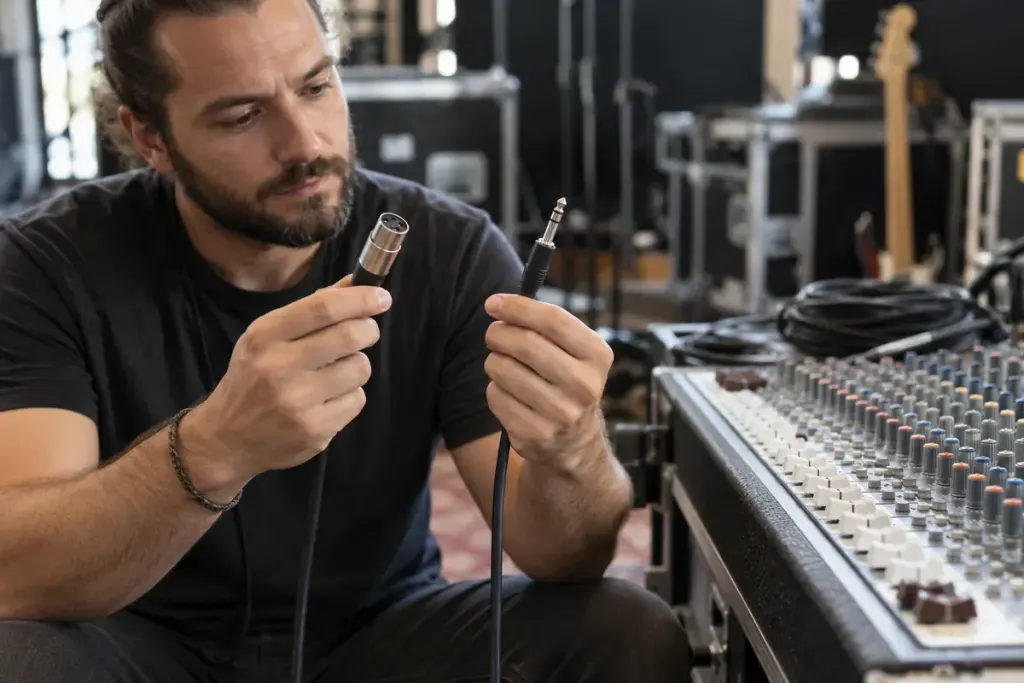
A cable with a three-contact jack can carry different kinds of signals. It might serve a balanced mono connection, stereo headphones or an insert connection. Recognising the plug is useful, but it does not establish how the equipment at either end is wired.
Yamaha’s interconnection guide explains these uses and warns that putting a TRS cable into an electric guitar does not turn its output into a balanced signal. The complete connection determines the behaviour.
Read the sockets as a pair
Check the source output and the receiving input in their manuals. Record whether each is balanced or unbalanced, its signal level and its connector wiring. A cable that physically fits can still be the wrong way to join two devices.
Balanced transmission allows a suitable receiver to reject interference appearing similarly on both signal conductors. That benefit depends on the circuit and wiring; it is not a promise that every noise problem disappears after buying a more expensive lead.
Make a connection list before soundcheck
For a small performance, list each source, destination and required cable. “Keyboard left output to mixer channel one” is clearer than “one jack cable”. Include any manufacturer-recommended interface or DI box where the equipment requires it.
Test one connection at a time at safe listening levels. If a problem appears, return to a known working arrangement and check the manuals rather than changing several adapters at once. Never remove protective mains earth connections to solve hum.
Keep stage cable labels about destinations and functions, not just connector names. A replacement technician should be able to understand what the cable is doing. Once the signal path is clear, choosing the appropriate lead becomes a practical equipment decision rather than a guess based on the number of rings on its plug.