Malta Looks Tiny on the Map, So Why Do Its Villages Feel Like Completely Different Worlds?
Sundown Malta >> Culture>> Malta Looks Tiny on the Map, So Why Do Its Villages Feel Like Completely Different Worlds?
Malta Looks Tiny on the Map, So Why Do Its Villages Feel Like Completely Different Worlds?
Malta can look deceptively simple when you first start planning a trip.
Valletta is the capital. Mdina is the historic walled city. The coast provides beaches and swimming spots. Gozo becomes a day trip. Add a few restaurants, take some photographs, and the itinerary seems complete.
Then you begin moving beyond the most famous places.
A short journey brings you to another town where the streets feel different. The church dominates a new skyline. The balconies change. A quiet square replaces the busy waterfront. Another village appears a few kilometres later, yet somehow it has its own atmosphere again.
That is one of the pleasures of exploring Malta villages.
Malta may be geographically compact, but its local character is not compressed into one uniform experience. For travellers willing to move beyond the headline attractions, villages can reveal a slower and more intimate side of the islands.
Malta’s Size Can Create the Wrong Expectation
Small countries often encourage fast travel.
When distances appear short, it is easy to assume everything can be seen quickly.
This creates itineraries where travellers move from Valletta to Mdina, then toward the coast, another town, a viewpoint, and finally dinner somewhere else—all within the same day.
It may be physically possible.
But travelling through Malta this way can turn individual communities into scenery seen from a bus or car window.
The interesting part is not simply arriving at another village.
It is noticing what changes when you do.
Malta’s identity reflects thousands of years of history, while its tourism landscape includes historic cities, coastal communities, countryside, food traditions, religious celebrations, and smaller village environments. Visit Malta
A slower itinerary gives those differences time to become visible.
Start with the Village Square
When arriving somewhere unfamiliar, resist the temptation to immediately search for the highest-rated attraction.
Instead, find the centre.
Many traditional Maltese settlements developed around a parish church and surrounding square, with older streets extending outward through the historic core. Malta Central
That layout makes the centre a useful place to begin exploring.
Walk around before deciding where to go next.
Notice where people stop for coffee.
Look at the façades surrounding the square.
See which streets appear residential and which contain small shops or restaurants.
Then choose one and start walking.
The objective is not to find a hidden attraction.
It is to understand the shape of the place.
Look Up at the Balconies Instead of Only at Your Map
Navigation apps are extremely useful in Malta.
But staring at a map while walking is also an effective way to miss half the destination.
Malta rewards looking upward.
Stone façades, enclosed balconies, shutters, religious details, doorways, narrow streets, and small architectural variations create much of the visual character of older neighbourhoods.
Some details may not have a famous story attached to them.
They do not need one.
Architecture can tell you that you have entered a place shaped over generations rather than constructed primarily for visitors.
When exploring Malta villages, spend some time walking without searching for anything specific.
A street does not need a landmark at the end to be worth walking.
Visit Early Enough to See the Village Wake Up
Timing can completely change a place.
Arrive around midday and you may encounter traffic, heat, visitors, and businesses already deep into the day’s rhythm.
Morning offers something different.
A café begins filling.
Deliveries arrive.
Residents cross the square.
Shop doors open.
Someone stops for a conversation that clearly was not scheduled.
Nothing dramatic needs to happen.
That is precisely the point.
Everyday routines can provide more context than another viewpoint because they show the destination functioning independently of tourism.
If your accommodation is located in or near a traditional village, use that advantage.
Go outside before your sightseeing day officially begins.
You may discover that the first hour becomes one of the most memorable.
Do Not Expect Every Village to Entertain You
This mindset matters.
Not every village needs museums, tours, souvenir shops, or a famous attraction.
Some places are interesting precisely because ordinary life remains their main activity.
If you arrive expecting constant entertainment, a quiet village can initially feel like there is “nothing to do.”
Change the question.
Instead of asking what there is to do, ask what there is to notice.
Walk.
Sit in the square.
Have coffee.
Look at the architecture.
Visit an appropriate public site if one is open.
Observe how the village connects to surrounding fields, roads, or neighbouring communities.
The experience becomes less transactional.
You are no longer waiting for the destination to perform for you.
Let a Local Bakery Become an Attraction
Food does not always need a reservation.
One of the easiest ways to make village exploration enjoyable is to build small food stops into the day.
Malta’s culinary identity reflects its Mediterranean setting and layers of historical influence, with familiar local foods including pastizzi and various bread, seafood, rabbit, bean, and pastry preparations. visitmalta.co.uk
You do not need to sample everything at once.
If you pass a small bakery or casual food shop that looks appealing, stop.
Buy something simple.
Eat slowly.
Continue walking.
A snack can tell you something about daily food culture while also creating a natural break in the itinerary.
And unlike a restaurant selected months before the trip, an unplanned bakery stop becomes connected to the specific street where you found it.
Notice How Quickly the Countryside Can Appear
One of the most enjoyable contrasts in Malta is the transition between built-up areas and more rural landscapes.
A village street can gradually lead toward fields, low stone walls, open views, or routes connecting nearby settlements.
Areas such as Mġarr, for example, combine a compact village environment with surrounding agricultural landscapes and access toward Malta’s western side. Visit Malta Now
This creates an opportunity to combine village exploration with walking.
Instead of arriving by vehicle, walking around the centre, then immediately leaving by vehicle, consider whether part of the surrounding area can safely become part of the experience.
The transition matters.
It shows how settlements relate to the landscape around them.
Give Churches Context, Not Just Camera Time
Churches are impossible to ignore in Malta.
They frequently dominate village skylines and can act as visual anchors long before you reach the centre.
For a visitor, it is easy to treat them mainly as architecture.
Take a photograph.
Admire the façade.
Move on.
But churches can also be deeply connected to local identity, celebrations, community history, and the organisation of village life.
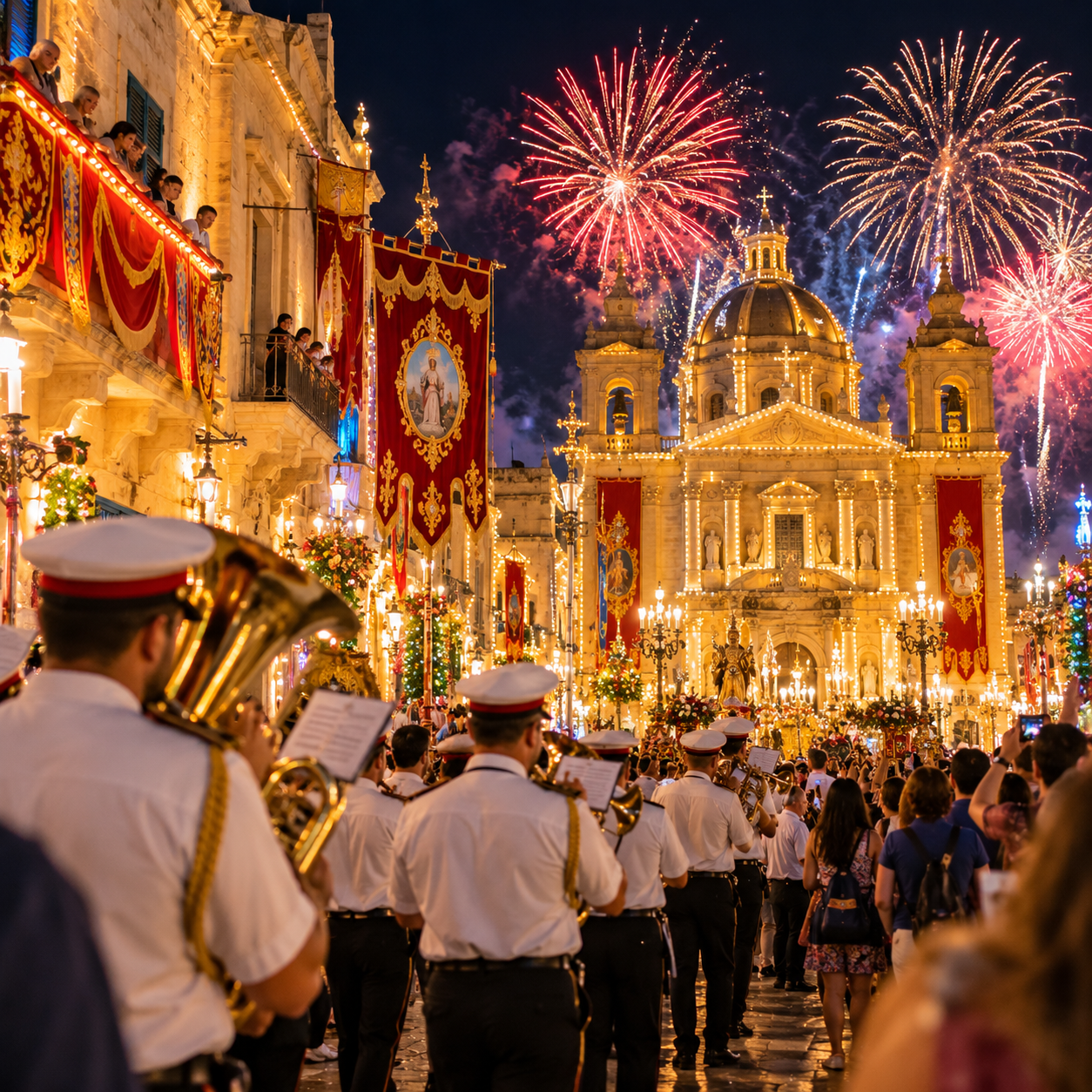
Malta’s village festas are particularly visible expressions of this relationship, combining religious tradition with processions, community gatherings, food, music, decorations, and fireworks. visitmalta.co.uk
Even if no festa is taking place during your visit, understanding that connection changes the way you see the square around the church.
It is not simply a photogenic centrepiece.
It can be part of the community’s social geography.
If You Encounter a Festa, Adjust the Schedule
A tightly planned itinerary sees an unexpected event as a logistical problem.
A flexible itinerary sees an opportunity.
If a village festa or other local celebration coincides with your trip, consider making room for it.
The atmosphere may be completely different from the village you would encounter on an ordinary weekday.
Streets become decorated.
Families and visitors gather.
Music and food become part of the environment.
Fireworks are strongly associated with Malta’s festa tradition. visitmalta.co.uk
The important thing is to remember that this is not a performance staged solely for tourists.
You are entering a community event.
Be respectful around religious activities, follow local instructions, and allow residents to participate without treating every moment as content for a camera.
Walk Without Trying to Find the Most Instagrammable Street
Travel photography can quietly change the way we explore.
Instead of looking at a destination, we start scanning it for backgrounds.
Which street looks best?
Where should someone stand?
Is the light right?
Can we reproduce the photograph we saw online?
There is nothing wrong with wanting beautiful pictures.
But try one experiment.
For twenty minutes, stop photographing.
Walk through the village without searching for an image.
Notice sounds instead.
A church bell.
Cutlery from a café.
Conversation through an open doorway.
Cars moving through narrow streets.
Wind around stone buildings.
When the camera stops controlling your attention, ordinary details become much easier to notice.
Stay for Lunch Instead of Immediately Moving On
A common village itinerary lasts roughly like this:
Arrive.
Walk around.
Photograph the church.
Buy something.
Leave.
Try staying longer.
Lunch provides a natural reason.
Once you know you are not leaving immediately, your pace changes. There is no need to rush through every street because the next destination is not pressing against the schedule.
Choose somewhere that suits your budget and interests.
Then allow the meal to separate the morning from the afternoon.
After eating, walk again.
The same streets may feel different now that they are slightly familiar.
That small sense of recognition is part of what makes slower travel rewarding.
Explore One Area Properly Instead of Collecting Five Villages
There is no prize for visiting the greatest number of Maltese villages in one day.
In fact, doing so can make them blur together.
Church.
Square.
Stone street.
Balcony.
Next village.
Instead, choose one or two places and give them enough time.
Perhaps combine a village centre with a nearby walk.
Or visit one community in the morning and stay through lunch before moving somewhere else later.
This is especially useful if exploring Malta villages is meant to help you understand local culture rather than simply produce a collection of photographs.
Depth creates distinction.
When you spend enough time somewhere, details begin attaching themselves to specific places.
Take Public Transport When It Fits the Day
Driving provides flexibility, particularly when combining rural locations or reaching places that would otherwise require several connections.
But a car is not automatically necessary for every village day.
Public transport can also change how you experience the island.
You wait where residents wait.
You enter communities through ordinary roads rather than arriving directly at a parking area beside an attraction.
You also avoid thinking about parking while walking.
The trade-off is time and flexibility.
So decide based on the itinerary rather than following a rule that one transport method is always superior.
If several destinations are scattered across the island, driving may make sense.
If you are visiting one area slowly, the slower journey can fit naturally into the day.
Do Not Ignore Gozo’s Villages
Village exploration becomes even more interesting when the trip includes Gozo.
Gozo is commonly presented as the quieter, greener counterpart to Malta’s main island, with its own villages, countryside, coast, historic places, and walking opportunities. visitmalta.co.uk
The mistake is trying to compress all of that into a frantic circuit.
Ferry over.
Rush between attractions.
Photograph everything.
Ferry back.
If your itinerary permits it, staying overnight gives Gozo room to feel like a destination rather than an excursion.
Morning and evening become available.
You can spend time in a village without constantly calculating how many major sights remain.
That changes the rhythm considerably.
Respect Residential Life
The most attractive street in a village may also be someone’s home.
That sounds obvious, but photography and social media can make boundaries surprisingly easy to forget.
Do not block doorways for photographs.
Avoid photographing residents at close range without permission.
Keep noise reasonable in quiet residential lanes.
Do not enter private courtyards simply because a door or gate happens to be open.
And remember that picturesque balconies and façades are not film sets.
Responsible village travel means enjoying local character without demanding that residents surrender their privacy for your experience.
This is particularly important when exploring places precisely because they feel less tourist-oriented.
Allow Yourself to Return Somewhere
Travellers often resist repetition.
If you have already visited a village, surely tomorrow should be used somewhere new.
Not necessarily.
Maybe you liked the square.
Perhaps you found a bakery you want to visit again.
Maybe the village was beautiful in the morning and you are curious about its atmosphere around sunset.
Returning changes the relationship.
The second time, you do not need to orient yourself constantly.
You already know where one street leads.
You recognise the café.
The unfamiliar begins to become slightly familiar.
Travel does not always become richer by constantly adding new places.
Sometimes it becomes richer by repeating a good experience.
The Best Village Day May Not Produce a Long Checklist
Imagine returning to your accommodation after spending most of the day in one area.
You visited a church.
Walked several streets.
Had coffee.
Bought lunch.
Walked toward the countryside.
Sat in a square.
Then returned.
On paper, it may look like you accomplished very little.
But travel memories are not created on paper.
You may remember the light on the limestone buildings.
The person serving your pastry.
The sound of the square.
A cat sleeping beneath a chair.
The breeze when the streets opened toward fields.
None of those experiences needs a ticket.
And none would necessarily appear on a “Top 10 Things to Do in Malta” list.
Conclusion
Malta’s compact geography makes it tempting to travel quickly.
But exploring Malta villages becomes far more rewarding when the objective is not simply to cover distance.
Choose fewer places. Walk their older streets. Spend time around the square. Try something from a bakery. Notice the architecture. Understand the role of the church and local traditions. Follow the landscape beyond the centre when appropriate, and stay long enough for the place to become more than another pin on your map.
Malta’s famous historic cities and coastline deserve attention.
But between those headline destinations are communities with their own rhythms and identities.
Sometimes the most memorable way to understand a small island is not to see more of it.
It is to stop somewhere long enough to notice the differences.
Related Post

You Hear Fireworks Over Malta—But There’s No National Holiday. You May Have Found a Village Festa
You are sitting outside somewhere in Malta. Maybe dinner has just arrived. Maybe you are…